
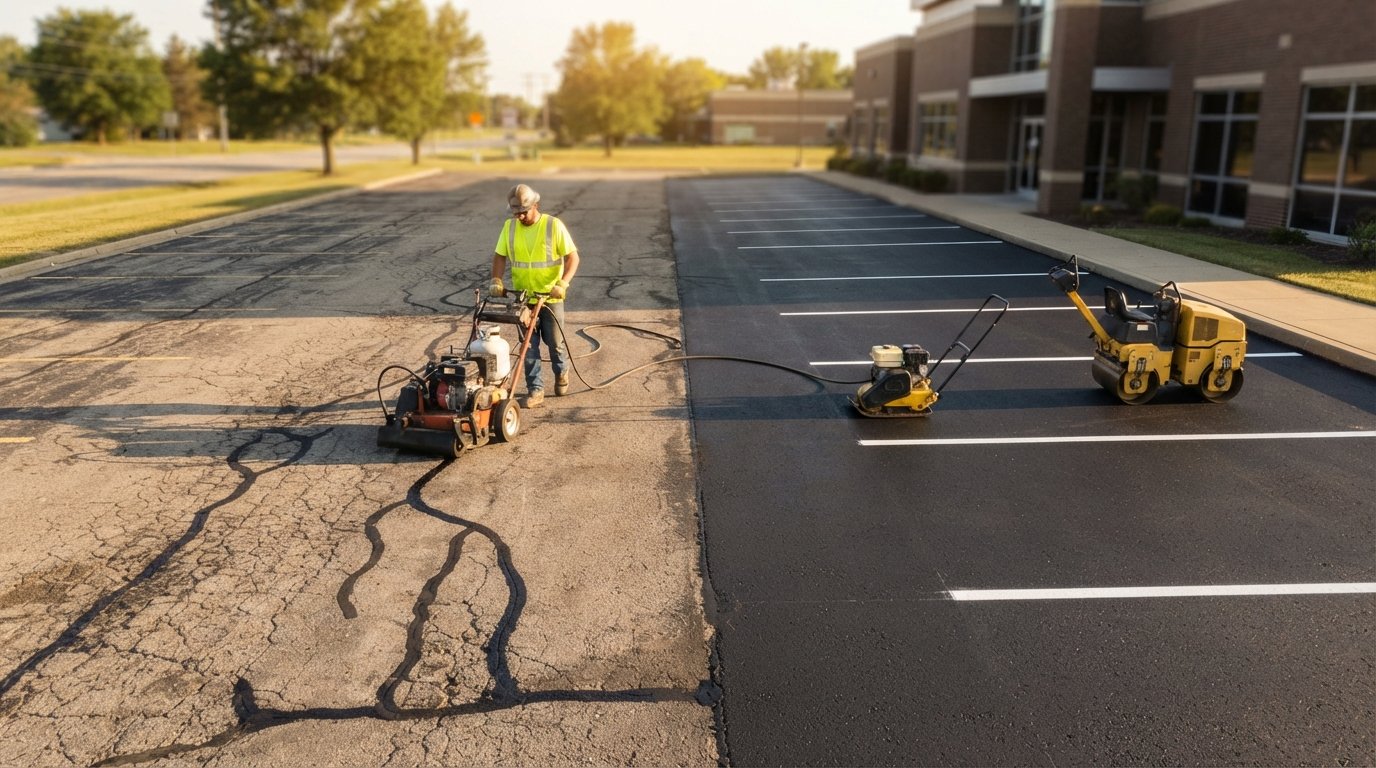
Asphalt Repair vs. Replacement: Cost Comparison Guide
Compare asphalt repair versus replacement costs and learn which option saves more long term. Call 9258629900 for expert guidance.

By Grace Young
Learn more about asphalt maintenance for guides, costs, and what to expect.
Planning a grading or paving job?
Send the project details, a budget range, and when you want to start.
Your parking lot is cracking, fading, and collecting potholes. Every tenant, student, and customer who drives across it notices. The question that keeps property managers, HOA boards, and school district facility directors up at night is simple: do I repair what I have, or do I tear it all out and start over? The asphalt repair versus replacement cost comparison is rarely a straightforward math problem. A repair that costs a few thousand dollars today can defer a much larger expense for years, but only if the underlying pavement still has enough life left to justify the investment. Choose wrong, and you will spend money twice.
DRT Grading & Paving works with commercial property developers, HOAs, and school districts across the East Bay and surrounding areas. We see both sides of this decision constantly: brand-new shopping centers and restaurant pads that need fresh asphalt from the ground up, and aging parking lots that need strategic maintenance to stay serviceable. This guide breaks down the real costs, the decision factors, and the practical framework we use when advising property owners on whether to repair or replace.
Understanding What Drives the Cost of Each Option
Before comparing numbers, it helps to understand what you are actually paying for. Asphalt repair and asphalt replacement are not simply two versions of the same service. They address different problems at different depths, and the cost structure reflects that.
Repair work focuses on localized failures. A pothole, a section of alligator cracking, a settled area near a drain: these are isolated problems that can be cut out and patched, sealed, or resurfaced without touching the rest of the lot. The cost is driven by the size of the affected area, the depth of the repair, and the accessibility of the work zone. Because the scope is limited, repair costs are typically measured in dollars per square foot of damaged pavement, not the entire lot.
Replacement, by contrast, involves removing the existing asphalt, addressing the base layer underneath, and laying new hot mix asphalt across the full area. The cost is driven by square footage, thickness of the new pavement, base repair requirements, and disposal fees for the old material. When you replace, you are paying for a new surface and the structural foundation that supports it. That is why replacement costs per square foot are significantly higher than repair costs per square foot, even though replacement solves the problem more permanently.
The table below provides a general range for planning purposes. Actual costs vary based on site conditions, regional pricing, and project specifics, so treat these as directional benchmarks rather than fixed quotes.
- Crack sealing: $0.50 to $2.00 per linear foot, ideal for early-stage cracking before water intrusion worsens the damage.
- Pothole patching: $3.00 to $8.00 per square foot, depending on depth and whether a full-depth repair is needed.
- Mill and overlay (resurfacing): $3.00 to $7.00 per square foot, which removes the top layer and places new asphalt over the existing base.
- Full-depth replacement: $6.00 to $15.00 per square foot, including removal, base repair, and new asphalt placement.
These ranges illustrate why the repair versus replacement decision matters so much. A 50,000-square-foot parking lot with widespread cracking might cost $150,000 to $350,000 to replace, but only $25,000 to $75,000 to repair strategically. The cheaper option buys time, but only if the pavement still has structural integrity left to preserve.
The Factors That Determine Whether Repair Is Enough
Not every cracked lot needs replacement, and not every repair is money well spent. The deciding factor is the condition of the asphalt and the base beneath it. If the base is sound and the damage is surface-level, repair is almost always the smarter financial move. If the base has failed, repair is a temporary patch that will not hold.
One of the most useful tools in this evaluation is the Pavement Condition Index, or PCI. This is a standardized rating from 0 to 100 that assesses cracking, rutting, potholes, and other distress indicators. A lot rated in the 70s or 80s is a strong candidate for preventive maintenance and localized repair. A lot in the 40s or 50s may still be repairable with a mill and overlay, but full replacement is likely within a few years. A lot below 30 is usually past the point where repair makes financial sense.
Beyond the PCI score, several specific conditions point toward repair as the right choice:
- Cracks are limited to the surface and have not begun to spread or widen significantly.
- Potholes are isolated and the surrounding pavement is still firm and stable.
- The base layer, visible during patch work, is dry and structurally sound.
- Drainage is working properly and water is not pooling on the surface.
- The lot is less than 15 to 20 years old and has not been neglected for extended periods.
When these conditions are present, a well-timed repair program can extend the life of your asphalt by five to ten years or more. Crack sealing alone, done every two to three years, is one of the highest-return maintenance activities available to property owners. It costs a fraction of replacement and prevents water from reaching the base, which is where the real damage begins.
However, repair has limits. If more than 25 to 30 percent of the pavement surface is distressed, patching individual areas becomes inefficient. You end up with a patchwork of repairs that fail at different rates, creating a maintenance headache and an uneven surface that is hard on vehicles and pedestrians. At that point, a mill and overlay or full replacement is usually more cost-effective over the life of the pavement.
When Replacement Becomes the More Cost-Effective Choice
Replacement is the larger upfront investment, but it is not always the more expensive decision in the long run. When pavement has reached the end of its serviceable life, repeated repairs become a financial drain. Each patch lasts a shorter time than the last, and the cumulative cost of ongoing repairs can exceed the cost of replacement within a few years.
The clearest signal that replacement is the better path is widespread structural failure. This includes:
- Alligator cracking across large areas, which indicates the base has failed and the asphalt can no longer support traffic loads.
- Deep rutting or depressions that create standing water and safety hazards.
- Multiple potholes that continue to reappear after patching.
- Pavement that has settled significantly around drains, curbs, or utility covers.
- A base layer that is saturated, soft, or contaminated with clay or organic material.
When these conditions exist, repair is a temporary fix at best. You might patch a pothole in January and see it return by spring. The money spent on those repeated repairs could have been applied toward a permanent solution. In these cases, replacement is not just the better long-term value; it is often the only way to restore a safe, functional surface.
There is also a safety and liability dimension. Severely deteriorated pavement creates trip hazards, vehicle damage risks, and potential liability for property owners. For school districts and HOAs, maintaining safe parking and drop-off areas is not optional. When pavement condition reaches a point where repairs cannot keep up with deterioration, replacement becomes a risk management decision as much as a financial one.
It is also worth considering the disruption factor. Repair work can often be phased to minimize impact on tenants and operations. Replacement requires more extensive closures and scheduling, but it is a one-time disruption rather than a recurring cycle of patch work. For property managers tired of explaining ongoing construction to tenants, replacement can be the cleaner operational choice.
The Long-Term Cost Picture: Lifecycle Analysis
The most accurate way to compare repair and replacement costs is to look at the total cost of ownership over a 20- to 30-year period. This is where the asphalt repair versus replacement cost comparison becomes clearer. A cheaper upfront option can become the more expensive choice if it leads to repeated repairs and premature failure.
Consider two scenarios for a 50,000-square-foot commercial parking lot. In the first scenario, the owner invests in a preventive maintenance program starting at year five. Crack sealing is performed every three years at a cost of roughly $5,000 to $10,000 per cycle. At year 15, a mill and overlay is performed at $4.50 per square foot, or approximately $225,000. The pavement then lasts another 15 years with continued maintenance. Total 30-year cost: roughly $300,000 to $350,000.
In the second scenario, the owner defers maintenance until problems become visible and urgent. By year 10, significant cracking has developed. Patching costs $30,000. By year 15, the patches are failing and more areas are deteriorating. Another $40,000 in repairs. By year 20, the pavement is beyond repair and requires full replacement at $10 per square foot, or $500,000. Total 30-year cost: roughly $570,000, plus the operational disruption of emergency repairs along the way.
The difference is stark. The owner who maintained the pavement spent less overall and avoided the headache of emergency repairs. The owner who deferred maintenance paid more and dealt with a deteriorating asset for years. This is the core argument for treating asphalt as a capital asset that requires ongoing investment, not a disposable surface to be ignored until it fails.
How DRT Grading & Paving Approaches the Decision
DRT Grading & Paving works with property owners across the East Bay to evaluate pavement condition and recommend the most cost-effective path forward. We do not push replacement when repair will serve you well, and we do not recommend repair when it is throwing money at a failing asset. Our approach is straightforward: assess the pavement, explain the options, and let the condition of the asphalt drive the recommendation.
For new commercial construction projects, such as shopping centers and restaurant sites, replacement is not a question. The asphalt is new, the base is engineered for the expected traffic loads, and the focus is on proper installation from the start. We handle grading and paving for projects ranging from Chick-fil-A and Raising Cane's locations to multi-tenant retail centers. When the ground is prepared correctly and the asphalt is placed to specification, the pavement performs as intended for decades with routine maintenance.
For existing properties, including HOA communities, school district parking lots, and commercial centers, we provide maintenance and repair services designed to maximize the life of your pavement. This includes crack sealing, pothole patching, seal coating, and mill and overlay work. When replacement is the right call, we handle the full scope: removal, base repair, grading, and new asphalt placement.
Our service area covers the East Bay and surrounding areas in California. If you are unsure whether your pavement needs repair or replacement, the best first step is an assessment. We can evaluate the condition of your asphalt, identify the underlying causes of distress, and provide a clear cost comparison for both options. That way, you can make an informed decision based on the actual condition of your property, not guesswork.
Practical Steps for Making the Decision
If you are facing the repair versus replacement question, here is a practical framework to guide your decision:
- Get a professional assessment. A qualified paving contractor can evaluate the pavement condition, identify the extent of structural damage, and provide a PCI rating or similar analysis.
- Request cost estimates for both options. Ask for a detailed breakdown of repair costs (by area and method) and replacement costs (including removal, base work, and new asphalt).
- Calculate the lifecycle cost. Compare the total cost of repair plus future maintenance against the cost of replacement over a 20- to 30-year horizon.
- Consider non-financial factors. Safety, liability, tenant satisfaction, and operational disruption all matter. A slightly cheaper repair that leaves hazardous conditions is not a good deal.
- Plan for preventive maintenance. Whether you repair or replace, commit to a maintenance schedule that protects your investment and avoids the deferred-maintenance trap.
The asphalt repair versus replacement cost comparison is not about finding the cheapest option today. It is about finding the option that delivers the best value over the life of your pavement. For some properties, that means strategic repairs that extend service life for years. For others, it means biting the bullet on replacement and starting fresh with a properly engineered surface.
DRT Grading & Paving is here to help you make that call with confidence. Whether you are developing a new commercial site or managing an aging parking lot, we bring the expertise to assess your situation and recommend the right solution. Get a quote, and let us help you protect your pavement investment.