Commercial Asphalt Paving for Chick-fil-A and Raising Cane's Sites
Commercial asphalt paving for Chick-fil-A and Raising Cane's sites, done right in the East Bay. Call 9258629900 for a quote.

By Caleb Foster
Learn more about asphalt maintenance for guides, costs, and what to expect.
Planning a grading or paving job?
Send the project details, a budget range, and when you want to start.
Opening a Chick-fil-A or Raising Cane's in the East Bay is a major milestone, and the parking lot is one of the first things customers touch. Before the first chicken sandwich or box combo is served, the site has to be graded, drained, and paved to handle heavy drive-thru traffic, delivery trucks, and California weather. Commercial asphalt paving for Chick-fil-A and Raising Cane's sites is not a generic parking lot job. It is a high-performance build that balances brand standards, municipal code, and the reality of hundreds of cars idling in a queue every single day.
DRT Grading & Paving handles new construction grading and asphalt for restaurant pads and shopping centers across the East Bay and surrounding areas. That work includes ground-up sites for national quick-service brands, where the margin for error on slope, compaction, and mix design is thin. A restaurant pad that fails inspection or develops rutting in the drive-thru lane within a year is a costly problem for the developer and the franchisee. Getting it right starts long before the paving crew arrives.
Why Restaurant Pad Sites Demand More Than Standard Paving
A typical office parking lot sees cars park and sit still for hours. A Chick-fil-A or Raising Cane's site is different. Vehicles queue in a tight loop, often idling for ten to twenty minutes, and that concentrated load sits on the same few square feet of asphalt all day. Add delivery trucks, trash haulers, and the occasional semi making a supply drop, and the pavement is under constant stress. Standard residential-grade asphalt will not hold up. These sites need a heavier structural section, tighter compaction, and a mix designed for slow-moving, heavy loads.
Drainage is another pressure point. Drive-thru lanes create long, narrow channels where water can pond if the grades are not set correctly. In the East Bay, where winter storms can dump inches of rain in a short window, a poorly drained restaurant lot turns into a liability. Standing water softens the subgrade, accelerates cracking, and creates slip hazards for customers and employees. Commercial asphalt paving for Chick-fil-A and Raising Cane's sites has to solve drainage before the first roller touches the mat.
There is also the matter of brand standards. National chains often have site design guidelines that specify pavement thickness, striping layout, ADA compliance, and even the color and condition of the finished surface. A paving contractor who has not worked with these brands may miss details that trigger rework. DRT Grading & Paving has completed new-construction grading and paving for Chick-fil-A and Raising Cane's locations, so the crew understands what these projects require from the ground up.
The Grading Phase: Setting the Foundation for a Restaurant Lot
Grading prepares the ground before asphalt goes down, and on a restaurant pad it is the single most important step. If the subgrade is soft, uneven, or poorly compacted, no amount of quality asphalt will save the finished lot. The grading crew has to strip unsuitable soils, bring in structural fill where needed, and compact in lifts to a specified density. On East Bay sites, that often means dealing with expansive clay soils that swell when wet and shrink when dry. Left untreated, those soils move under the pavement and crack it from below.
Slope and elevation control are equally critical. The finished grades have to move water away from the building, away from the drive-thru lane, and toward catch basins or biofiltration areas without creating trip hazards or ponding. On a tight restaurant pad, a fraction of a percent in the wrong direction can mean a puddle at the pickup window. The grading plan also has to account for utility trenches, grease interceptors, and underground detention systems, all of which can settle differently than the surrounding soil if not compacted properly.
Here is how a typical restaurant pad grading sequence looks on a DRT project:
- Clear and grub the site, then strip topsoil and unsuitable material to the depth specified by the geotechnical engineer.
- Scarify and recompact the exposed subgrade, then bring in structural fill in lifts, testing density as the pad rises.
- Fine grade to the approved plan, setting precise elevations for the building pad, drive-thru lane, parking stalls, and drainage swales.
- Proof-roll the finished subgrade and correct any soft spots before the asphalt crew mobilizes.
Each of those steps protects the next. A proof-rolled subgrade that passes inspection gives the paving crew a stable platform, which in turn gives the franchisee a lot that will not rut or crack prematurely. Skipping or rushing grading is the most common reason restaurant parking lots fail early.
Asphalt Paving Specifications for High-Traffic Restaurant Sites
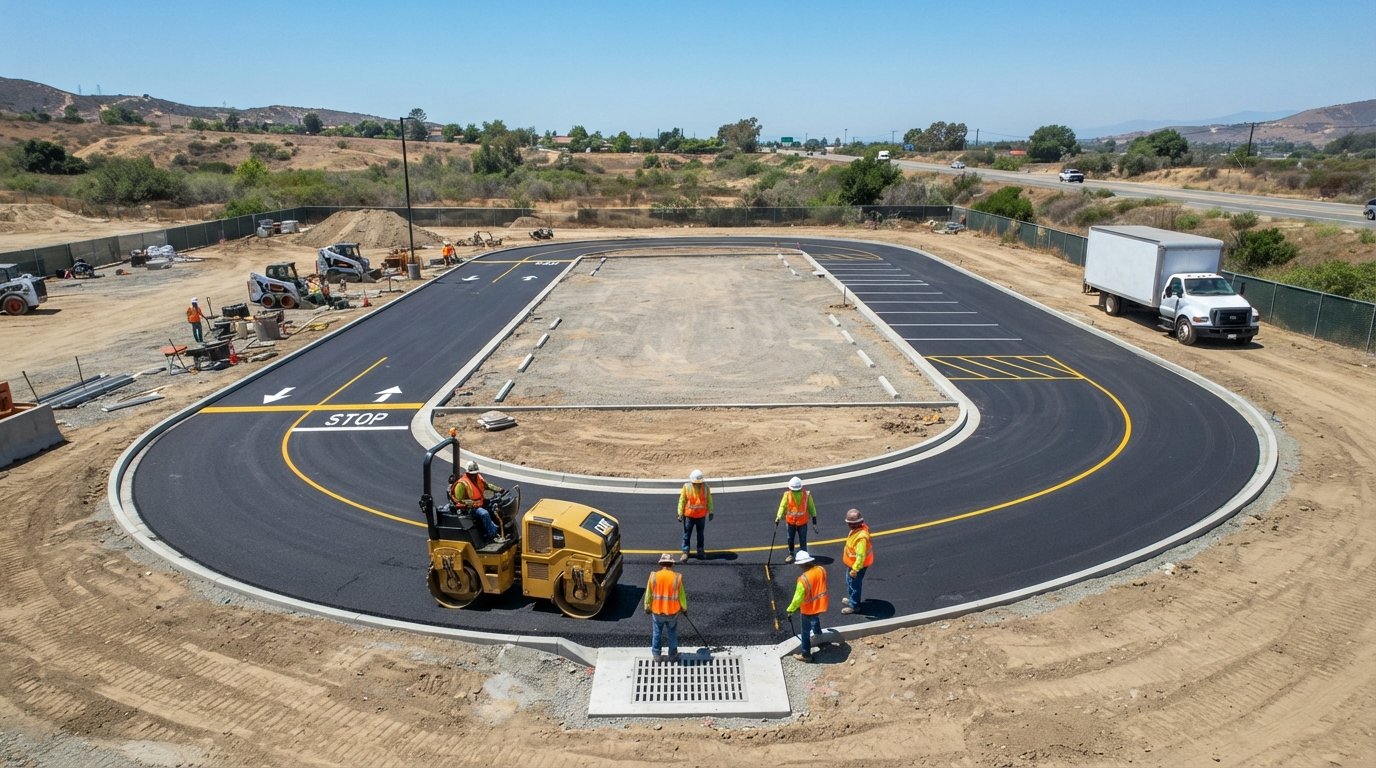
Once the subgrade is approved, the paving phase begins. For a Chick-fil-A or Raising Cane's site, the asphalt section is typically thicker than what you would see on a low-volume lot. The exact thickness depends on the geotechnical report and the expected traffic load, but restaurant pads commonly call for a compacted aggregate base topped with multiple lifts of hot-mix asphalt. The drive-thru lane and truck route may require additional thickness or a modified mix to resist rutting.
Mix design matters as much as thickness. Slow-moving traffic in hot weather is the enemy of standard asphalt. It can shove and rut under tires that sit in the same spot for minutes at a time. A stiffer mix, often using a polymer-modified binder, performs better in those conditions. The paving crew also has to manage joint placement, compaction temperatures, and mat density to avoid early failures at the seams between lanes and around utility covers.
Key specification points for commercial asphalt paving for Chick-fil-A and Raising Cane's sites include:
- Compacted aggregate base installed to the geotechnical engineer's specified depth and density.
- Hot-mix asphalt placed in lifts, with each lift compacted to the required density before the next is applied.
- Polymer-modified or otherwise stiffened mix in drive-thru lanes and truck paths to resist rutting.
- Clean, properly tacked joints between paving lanes and around structures to prevent water intrusion.
- ADA-compliant slopes and transitions at accessible parking stalls and ramps.
DRT Grading & Paving coordinates the asphalt scope with the general contractor, the franchisee's site inspector, and the local jurisdiction so that the finished lot meets both the brand's standards and the city's inspection requirements. That coordination is what keeps a restaurant opening on schedule instead of stalled over a failed paving inspection.
Drive-Thru Lanes, Truck Routes, and the Details That Fail First
If you want to know where a restaurant parking lot will fail first, look at the drive-thru lane and the truck route. Those are the areas where loads are heaviest, speeds are slowest, and drainage is most difficult. The drive-thru loop often has tight radii, which means the paving crew has to place and compact asphalt in confined spaces without leaving low spots or weak joints. Any imperfection there shows up quickly as rutting, shoving, or cracking.
Truck routes and delivery zones face similar pressure. A loaded supply truck turning into a narrow service area can tear up a pavement edge that was not properly confined. Edge restraint, thickened edges, and adequate base support are the fixes, and they have to be designed in during grading, not added later. DRT's experience on restaurant pads means these details are addressed in the plan rather than discovered after the first delivery truck arrives.
Striping and signage are the final layer of function. Drive-thru lanes need clear directional markings, and parking stalls need to meet local code for count and accessibility. A well-paved lot with confusing striping creates traffic problems that no amount of asphalt quality can solve. The paving and striping scopes should be coordinated so the layout matches the approved site plan exactly.
Scheduling and Coordination for East Bay Restaurant Projects
Restaurant construction schedules are aggressive. Franchisees often have opening dates tied to marketing commitments, lease terms, and staffing plans. A delay in grading or paving cascades into every trade that follows. On an East Bay restaurant pad, the paving window is also weather-dependent. Asphalt needs dry conditions and suitable temperatures, and winter rains can shut down placement for days at a time. Planning the paving phase for the dry season, or building in float for weather, is part of keeping the project on track.
Permitting adds another layer. East Bay cities have their own requirements for grading permits, stormwater control, and final paving inspections. A contractor who works regularly in the region knows which jurisdictions require what, and can prepare submittals and schedule inspections without losing weeks to back-and-forth. DRT Grading & Paving works throughout the East Bay and surrounding areas, so the team is familiar with local review processes and inspection timelines.
Coordination with the building contractor is also essential. The paving crew needs a building pad that is ready, utilities that are staked and protected, and a site that is clear of stored materials. Sequencing paving after the heavy construction traffic has finished, but before the owner needs the lot for training and deliveries, takes planning. A contractor who has done restaurant pads before knows how to slot the paving work into that window.
Maintenance After Opening: Protecting the Investment
A new restaurant parking lot is not a one-time expense. It is an asset that needs care from the day it opens. Sun, rain, oil drips, and constant traffic all take a toll. The most cost-effective maintenance program starts early, with sealcoating and crack sealing scheduled before small problems become structural failures. For a high-traffic Chick-fil-A or Raising Cane's lot, that typically means a maintenance cycle that includes regular inspections, prompt crack repair, and periodic sealcoating.
Ignoring maintenance is expensive. Water gets into cracks, freezes, and expands, and the damage spreads. A crack that could have been sealed for a few hundred dollars can turn into a full-depth repair that costs thousands. For franchisees and property owners in the East Bay, a scheduled maintenance plan protects both the pavement and the customer experience. A cracked, faded lot sends the wrong message before a customer even reaches the ordering lane.
DRT Grading & Paving provides asphalt maintenance for existing commercial properties, including restaurant sites, shopping centers, HOAs, and school districts. That means the same company that can build a new restaurant pad can also keep it in service years later. For developers and franchisees managing multiple locations, having one contractor for both new construction and ongoing care simplifies scheduling and accountability.
Common Mistakes on Restaurant Pad Paving Projects
Most restaurant lot failures trace back to decisions made before paving. Understanding those mistakes helps developers and franchisees ask the right questions during contractor selection. The most common issues include:
- Insufficient subgrade compaction, which leads to settlement and cracking under the drive-thru lane.
- Drainage grades that pond water at the pickup window or in the drive-thru loop.
- Using a standard mix in the drive-thru lane instead of a stiffer, rut-resistant design.
- Poor joint construction that lets water into the base and weakens the pavement.
- Skipping maintenance until cracks are widespread, turning repairable issues into full replacements.
Each of those mistakes is avoidable with the right contractor and the right plan. The cost of doing it right the first time is far lower than the cost of tearing out and replacing a failed lot while a restaurant is trying to operate. For a brand like Chick-fil-A or Raising Cane's, where customer experience is everything, the parking lot is part of the product.
Commercial asphalt paving for Chick-fil-A and Raising Cane's sites is a specialty within commercial paving. It requires grading expertise, mix design knowledge, drainage planning, and the ability to coordinate with national brand standards and local jurisdictions. DRT Grading & Paving brings all of that to East Bay projects, from the first cut of the grader to the final stripe. If you are developing a restaurant pad or maintaining an existing one, the team can help you get the pavement right.