Commercial Paving Cost Factors in the East Bay
Commercial paving cost factors East Bay guide covering grading, materials, and permits. Call 9258629900 for a clear, itemized estimate.

Learn more about asphalt maintenance for guides, costs, and what to expect.
Planning a grading or paving job?
Send the project details, a budget range, and when you want to start.
If you own or manage commercial property in the East Bay, you already know that pavement is one of your most visible and heavily used assets. It carries delivery trucks, school buses, customer vehicles, and daily foot traffic. When it comes time to repair, replace, or install asphalt, the price tag can feel unpredictable. Quotes for what looks like the same parking lot can swing by tens of thousands of dollars. Understanding what actually drives those numbers is the fastest way to budget accurately and avoid surprise bills later.
This guide breaks down the real commercial paving cost factors East Bay property owners and developers face, from site grading and soil conditions to materials, permits, and long-term maintenance. Whether you are preparing a new restaurant pad, repaving a shopping center lot, or planning summer work for a school district, knowing these variables puts you in control of the conversation.
Why East Bay Paving Costs Vary So Much
The East Bay is not one uniform market. A lot in Concord sits on different soil, faces different weather, and falls under different permitting rules than a site in Fremont or Oakland. That geographic spread is one of the biggest reasons paving estimates diverge. Contractors pricing work in the East Bay have to account for localized conditions that do not show up on a simple square-footage quote.
Beyond geography, the scope of work matters enormously. A maintenance job like crack sealing or sealcoating on an existing lot is a completely different project than ground-up construction that requires grading, base rock, and new asphalt. Mixing those two categories in your mind will make every bid look inconsistent, when in reality the contractors may be pricing entirely different scopes.
Timing also plays a role. Asphalt plants, trucking, and labor are all subject to seasonal demand. Scheduling work during the busiest paving months can cost more than planning ahead for a slower window. Property managers who understand this rhythm often save money simply by being flexible.
The Core Cost Factors That Drive Your Quote
When a reputable contractor builds an estimate, several inputs feed into the final number. Each one can shift the price up or down, and understanding them helps you compare bids apples to apples instead of guessing why one is higher.
- Site grading and subgrade preparation: The ground has to be shaped, compacted, and stabilized before asphalt goes down. Poor subgrade means premature failure, so this step cannot be skipped.
- Square footage and layout: Larger areas cost more overall but often less per square foot. Complex layouts with islands, curbs, and tight corners add labor time.
- Asphalt thickness and mix design: Heavy-duty lots used by trucks need thicker lifts and stronger mixes than standard passenger vehicle parking.
- Drainage and stormwater requirements: Proper slope, catch basins, and drainage corrections protect the pavement and satisfy local codes.
- Permits, inspections, and compliance: East Bay cities and counties each have their own requirements, and those administrative steps carry real costs.
Notice that materials are only one part of the equation. Labor, equipment, hauling, and compliance often make up a larger share than property owners expect. A bid that looks low on materials may be cutting corners on preparation, which is exactly where long-term failures begin.
How Site Grading and Soil Conditions Affect Pricing
Grading is the foundation of every successful paving project. If the subgrade is not properly prepared, even the best asphalt will crack, settle, and rut within a few years. In the East Bay, soil conditions vary widely, and that variability directly affects cost.
Some sites have expansive clay soils that swell when wet and shrink when dry. Others have loose fill or old debris that must be removed and replaced. A contractor who encounters unexpected soil problems mid-project has to bring in additional base rock, re-compact the subgrade, or import engineered fill. Those corrections are necessary, but they add cost.
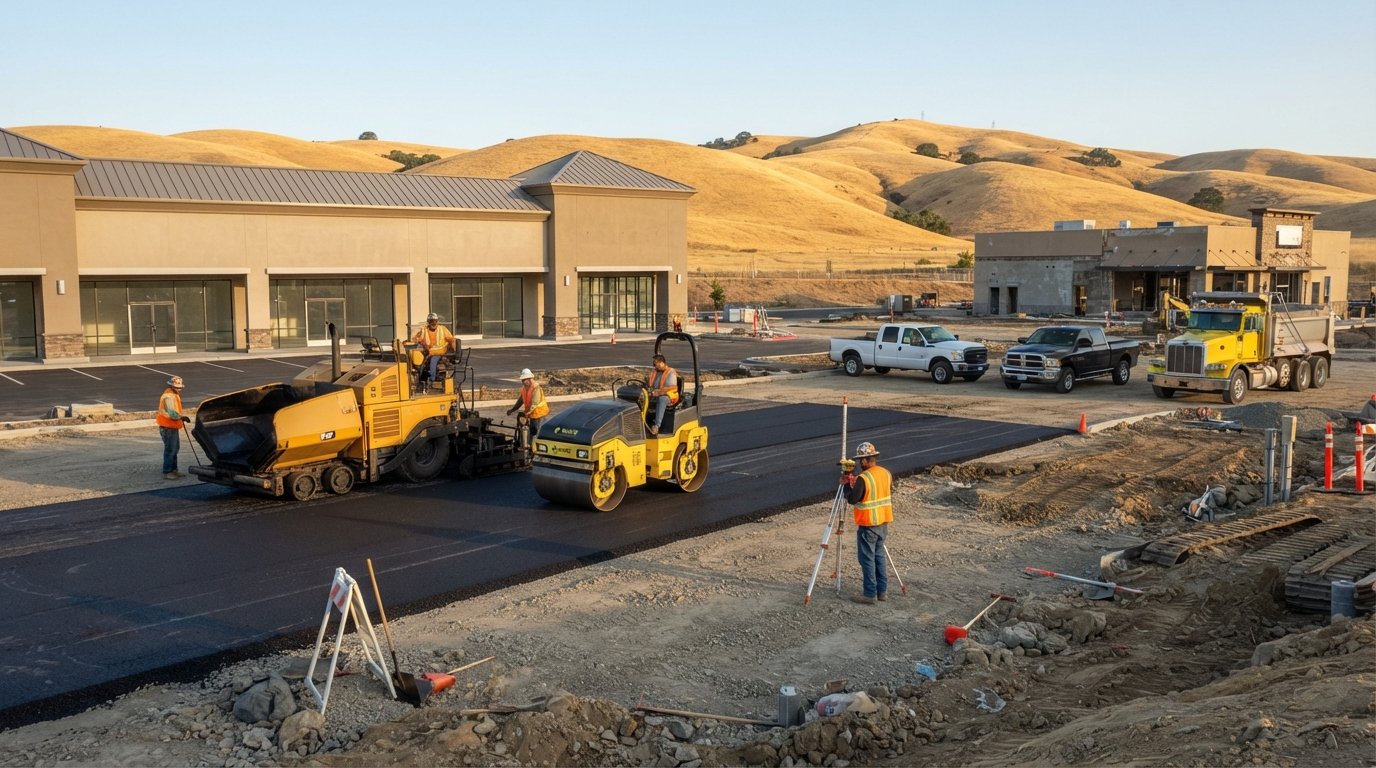
This is why a thorough site evaluation before the bid matters. Developers working on new commercial sites, including restaurant pads and shopping centers, benefit from having grading and paving handled by the same experienced team. When one contractor owns both phases, the transition from rough grade to finished asphalt is smoother, and surprises are caught earlier.
Drainage Corrections and Water Management
Water is asphalt's biggest enemy. Standing water softens the subgrade, and freeze-thaw cycles (where applicable) or heavy winter rains accelerate deterioration. Correcting drainage during a repave often means adjusting slope, adding or repairing catch basins, or redirecting runoff away from the pavement.
These corrections are not glamorous, but they are far cheaper than replacing a failed lot in five years. Property owners who skip drainage work to save money upfront frequently pay double later. A good paving partner will flag drainage issues during the estimate and explain the tradeoffs clearly.
Materials, Thickness, and Mix Design
Asphalt is not a single product. It is a engineered mixture of aggregate, binder, and additives, and the recipe changes based on how the pavement will be used. A standard parking lot for passenger cars can use a lighter mix and thinner lifts. A truck court, loading zone, or bus loop needs a heavier-duty design.
Thickness is usually expressed in inches of compacted asphalt over a base layer of crushed rock. Getting this right requires understanding traffic loads, soil strength, and local climate. Overbuilding wastes money; underbuilding guarantees early failure. Experienced contractors calibrate thickness to the actual use of the lot rather than applying a one-size-fits-all number.
Material prices also fluctuate with oil markets, since asphalt binder is a petroleum product. That means the same project can cost more or less depending on when you buy. Locking in pricing during a stable window, or planning around known fluctuations, is a legitimate cost-control strategy.
Permits, Regulations, and East Bay Jurisdictions
The East Bay is a patchwork of cities and counties, each with its own permitting process, inspection requirements, and stormwater rules. A project in one city may need different approvals than an identical project a few miles away. These differences add time and administrative cost to every bid.
Some jurisdictions require traffic control plans, erosion control measures, or specific stormwater best management practices during construction. Others have noise ordinances that limit working hours, which can stretch a project over more days and increase labor cost. Contractors who work regularly in a given city know these rules and build them into their estimates.
For developers, factoring permitting timelines into the schedule is just as important as factoring cost. A delayed permit can push paving into a rainy window, which then delays the entire project. Local expertise pays for itself here.
Maintenance Versus New Construction: Two Different Budgets
One of the most common sources of confusion is comparing maintenance pricing to new construction pricing. They are fundamentally different scopes, and treating them as interchangeable leads to bad decisions.
Maintenance work, such as sealcoating, crack filling, patching, or striping, is about extending the life of existing pavement. It is generally lower cost per square foot and can often be scheduled in phases to fit a budget. New construction, by contrast, includes grading, base preparation, and full asphalt installation. It is a capital project, not a line-item expense.
Property managers for HOAs, school districts, and similar organizations often need both. A smart approach is to invest in regular maintenance to delay the day when full replacement becomes necessary. That strategy stretches capital budgets and keeps lots safer for users.
When Maintenance Becomes Replacement
At some point, maintenance stops being cost-effective. If a lot has widespread alligator cracking, deep potholes, or base failure, patching is just a temporary fix. Recognizing that threshold is where an experienced paving contractor adds real value, because they can show you the math on repair versus replace.
Ignoring that threshold is expensive. Property owners who keep patching a failing lot often spend more over five years than they would have spent replacing it once, correctly, at the start.
How to Compare Paving Bids Fairly
Comparing bids is not about picking the lowest number. It is about understanding what each contractor is actually proposing. A bid that excludes grading, drainage, or permits is not cheaper; it is incomplete.
- Check the scope: Does the bid include grading, base rock, compaction, drainage, and cleanup? Or just asphalt placement?
- Verify thickness and mix: Ask for the compacted thickness and the asphalt mix design in writing.
- Confirm licensing and insurance: A legitimate contractor carries proper coverage and can provide documentation.
- Ask about scheduling: When will work start and finish, and how will weather or permits affect the timeline?
- Request references: Past commercial projects in the East Bay are the best proof of capability.
A transparent contractor will welcome these questions. If a bidder is evasive about scope or materials, that is a warning sign. The cheapest bid is rarely the best value when the pavement fails early.
Planning Ahead to Control Costs
The single most effective way to control commercial paving costs in the East Bay is to plan ahead. Emergency repairs always cost more than scheduled maintenance. Last-minute construction always costs more than a project that was designed and permitted properly.
For HOAs and school districts, that means building pavement into a multi-year capital plan and scheduling work during breaks or low-traffic windows. For developers, it means bringing grading and paving expertise into the project early, before site plans are finalized, so that drainage and subgrade issues are addressed on paper rather than in the field.
Working with a local contractor who understands East Bay soils, jurisdictions, and weather patterns turns cost estimation from guesswork into a predictable process. That predictability is what lets you budget confidently and avoid surprise bills.
DRT Grading & Paving handles both new construction grading and asphalt for shopping centers and restaurant sites, as well as ongoing asphalt maintenance for HOAs, school districts, and other properties across the East Bay. If you are planning a project, request a quote and get a clear, itemized estimate built on local experience.