Grading and Drainage for Restaurant Pad Sites
Proper grading and drainage for restaurant pad sites protects your investment. Call DRT Grading & Paving at 9258629900 for East Bay expertise.

By Grace Young
Learn more about grading for guides, costs, and what to expect.
Planning a grading or paving job?
Send the project details, a budget range, and when you want to start.
A restaurant pad site is one of the most unforgiving pieces of commercial real estate you can build on. The building is small, the parking field is tight, and the drive-thru lane wraps around a structure that cannot move once the slab is poured. If the ground beneath that slab is not shaped correctly and the stormwater has nowhere to go, you will find out the hard way during the first heavy winter storm in the East Bay. Water will pond against the building, saturate the subgrade, and start working on the asphalt and concrete before the grand opening banners come down.
This is why grading and drainage for restaurant pad sites deserves its own plan, not a line item borrowed from a generic sitework package. Quick-service restaurants, coffee shops with mobile order lanes, and fast-casual concepts all put unusual demands on a small footprint. Grading prepares the ground before asphalt goes down, and drainage decides whether that asphalt survives a decade of rain events, grease interceptor discharge, and constant delivery truck traffic.
DRT Grading & Paving handles new construction grading and asphalt for restaurant sites and shopping centers across the East Bay, including work on Chick-fil-A and Raising Cane's locations. That experience shows up most in the details of pad elevation, slope, and water management. Here is how the process actually works, and what developers and owners should watch for.
Why Restaurant Pads Are Harder to Grade Than They Look
A big-box retail pad has room to spread water across a wide parking field. A restaurant pad rarely does. The building, drive-thru lane, trash enclosure, grease interceptor, and menu board all compete for the same few thousand square feet. Every one of those elements changes how water moves across the site, and every one of them sits close to the building, where ponding causes the most expensive damage.
Restaurant pads also carry loads that ordinary retail parking does not. Delivery trucks, garbage trucks, and grease service vehicles all track over the drive aisle. The drive-thru lane itself takes a continuous stream of passenger vehicles at low speed, which is hard on the surface course but even harder on the base if water has weakened it. Grading has to account for these loads from the first cut of the subgrade.
Then there is the schedule problem. Restaurant projects move fast because franchise agreements and opening dates are tied to revenue. Grading and drainage work has to be right the first time, because there is rarely a window to tear out base and redo it. A contractor who understands restaurant pads builds that certainty into the sequence, from rough grading through final paving.
The Grading Sequence for a Restaurant Pad Site
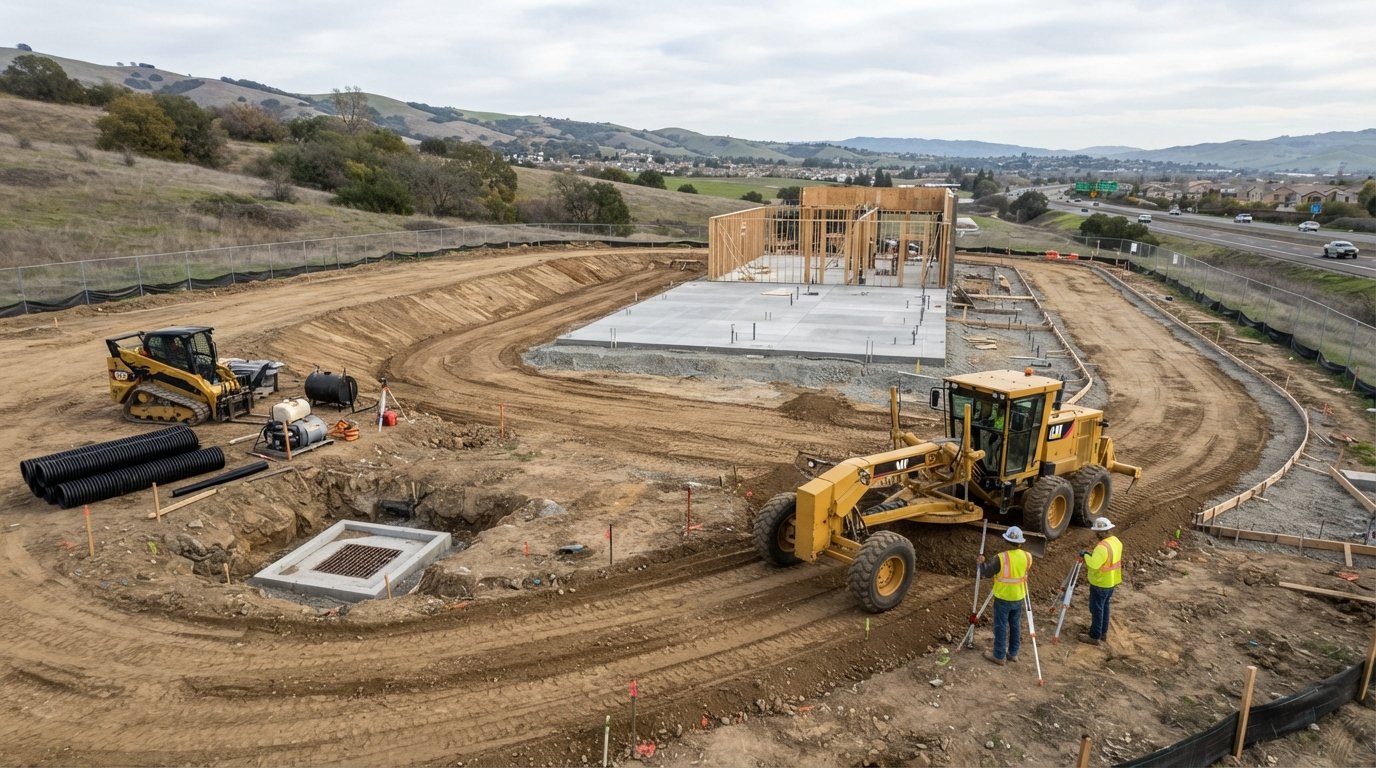
Grading is not a single step. On a restaurant pad, it is a series of controlled passes that move the site from raw dirt to a shaped, compacted surface ready for base rock and asphalt. Skipping or rushing any pass creates problems that show up later as cracking, settlement, or standing water.
The work typically follows this order:
- Clearing and grubbing. Remove vegetation, old pavement, and debris. Any organic material left in place will decompose and settle under the new pad.
- Rough grading. Cut and fill to bring the site close to final elevation, using the civil engineer's pad plan as the target.
- Subgrade preparation. Scarify, moisture-condition, and compact the native soil so it can carry the building and pavement loads.
- Fine grading. Shape the surface to precise elevations so water flows toward inlets and off the pad without ponding.
- Base rock placement. Install and compact aggregate base at the depth specified for restaurant traffic, including drive-thru and delivery routes.
Each of these steps is verified against the plan before the next one starts. On a restaurant pad, the margin for error is small because the building pad, drive-thru lane, and parking stalls all need to drain without sending water into the wrong place. A pad that is two inches off can turn a drive-thru apron into a puddle that customers drive through every morning.
Designing Drainage Around a Small, Busy Footprint
Drainage for a restaurant pad is a system, not a single pipe. It includes surface slope, catch basins, area drains, trench drains, and the connection to the municipal storm system or an on-site detention facility. The goal is to move water off the pad quickly and keep it away from the building, the drive-thru lane, and the trash enclosure.
Restaurants generate several water sources that a standard retail pad does not. Roof runoff from a large, low-slope roof concentrates at downspouts. Grease interceptors and dumpster pads produce wash-down water that has to be contained. Drive-thru lanes and menu board areas collect trash and food waste that can clog grates. A drainage plan that ignores these sources will fail even if the pipe sizing is technically correct.
Two design habits make the biggest difference on restaurant pads. First, slope the pad away from the building on all sides, with positive fall to inlets or to the parking field edge. Second, place inlets where water actually collects, not just where the plan shows a convenient pipe run. On a tight pad, a well-placed trench drain at the drive-thru lane and a pair of area drains near the trash enclosure often do more good than a larger pipe network.
Slope, Elevation, and the Numbers That Matter
Most jurisdictions in the East Bay require a minimum pavement slope of about two percent for asphalt and one percent for concrete, with some variation by city and by surface type. Those minimums exist because water needs enough energy to keep moving, especially when the surface is rough or partially clogged with debris.
On a restaurant pad, the practical target is usually a bit steeper than the minimum in the parking field and flatter near the building, where accessibility requirements and door thresholds limit how much fall is available. The building pad itself has to sit high enough that water cannot reach the slab or the interior, which typically means the finished floor elevation is set above the surrounding pavement by several inches.
Getting these elevations right is a coordination job. The civil engineer sets the pad and drainage plan, the architect sets the building floor elevation, and the grading contractor has to hit both while keeping the drive-thru lane and parking stalls usable. DRT Grading & Paving works through these conflicts on the plan before dirt moves, which is far cheaper than solving them with change orders after the pad is shaped.
Common Drainage Mistakes on Restaurant Sites
Most drainage failures on restaurant pads trace back to a handful of recurring mistakes. They are worth reviewing on every project, because each one is inexpensive to prevent and expensive to fix.
- Ponding at the drive-thru lane. Water collects where vehicles stop, creating slip hazards and accelerating asphalt deterioration.
- Undersized or misplaced inlets. Grates that clog with food waste and trash stop working within months of opening.
- Flat spots in the parking field. Areas that meet the minimum slope on paper but do not drain in practice because of construction tolerance.
- Poor connection to the storm system. Discharge points that back up during heavy rain because the downstream system was not verified.
- Ignoring grease and wash-down water. Interceptor discharge routed to the wrong place can create code violations and long-term pavement damage.
Each of these problems shows up first as a complaint from a tenant or a customer, then as a repair bill. On a restaurant pad, the repair often requires closing part of the drive-thru or parking field, which costs the operator revenue. Preventing the problem during grading and drainage construction is almost always the better investment.
Working With the Right Contractor in the East Bay
Restaurant pad projects in the East Bay come with local conditions that out-of-area contractors often miss. Soils vary from expansive clay to sandy loam within a few miles. Winter rain arrives in concentrated storms that test drainage systems in a single weekend. Cities like Concord, Walnut Creek, and Pleasanton each have their own plan check and inspection habits. A local contractor who has graded and paved restaurant sites in these jurisdictions knows what the inspectors look for and how to sequence work around the rainy season.
DRT Grading & Paving focuses on new construction grading and asphalt for shopping centers and restaurant sites, along with asphalt maintenance for HOAs, school districts, and other properties. That mix matters because it means the same crew that shapes a pad for a new Chick-fil-A or Raising Cane's also understands how pavement performs years later. The goal on every restaurant pad is a surface that drains correctly on day one and still drains correctly after a decade of traffic and weather.
For developers and owners, the practical takeaway is simple. Treat grading and drainage for restaurant pad sites as a design and construction priority, not a commodity scope. Verify elevations and slopes before base rock goes down. Confirm that inlets and trench drains are placed where water actually collects. And work with a contractor who has done it before on the same kind of site.
If you are planning a restaurant pad or shopping center project in the East Bay, DRT Grading & Paving can review your plan, walk the site, and provide a quote for grading, drainage, and asphalt work. Reach out at 9258629900 to start the conversation.