
New Construction Asphalt Paving for Commercial Lots
Explore the new construction asphalt paving process for commercial lots and learn how proper grading and paving prevent costly failures. Call 9258629900 for a quote.

By Yara Walsh
Learn more about grading for guides, costs, and what to expect.
Planning a grading or paving job?
Send the project details, a budget range, and when you want to start.
A commercial lot is only as strong as the ground beneath it. Developers who rush the grading and paving phase often discover the hard way that shortcuts surface later as cracking, settling, and costly repairs. Understanding the new construction asphalt paving process for commercial lots gives you a clear roadmap from raw dirt to a finished parking surface that can handle traffic, weather, and time. Whether you are building a shopping center, a restaurant pad, or a mixed-use development in the East Bay, knowing what happens at each stage helps you hold contractors accountable, control your budget, and avoid surprises that stall your certificate of occupancy.
Why the Paving Process Matters for Commercial Development
Commercial pavement carries loads that residential driveways never see. Delivery trucks, garbage haulers, and daily customer traffic all stress the asphalt surface and the subgrade below it. When the new construction asphalt paving process for commercial lots is followed correctly, each layer works with the others to distribute weight, drain water, and resist deformation. When it is rushed or poorly sequenced, the entire system fails early.
For developers, the stakes go beyond pavement condition. A parking lot that fails inspection or shows premature cracking can delay tenant openings, trigger warranty disputes, and damage relationships with buyers or leasing agents. Restaurant sites like Chick-fil-A and Raising Cane's, for example, have specific drive-thru and queuing lane requirements that demand precise grading and a smooth, durable surface. Getting the process right the first time protects your schedule and your reputation.
The process also affects long-term maintenance costs. A properly built commercial lot may need only routine sealcoating and crack filling for years. A poorly built one can require full-depth repairs or even reconstruction within a few seasons. Investing in the correct process upfront is almost always cheaper than fixing problems later.
The New Construction Asphalt Paving Process for Commercial Lots: Step by Step
The sequence from bare ground to finished pavement follows a logical order, but each step must be completed to specification before the next begins. Skipping or compressing any phase undermines the final result. Below is the standard progression for new commercial construction.
- Site assessment and planning: Engineers and paving contractors review soil conditions, drainage patterns, expected traffic loads, and local code requirements. This phase determines pavement thickness, base depth, and grading elevations.
- Clearing and grubbing: Vegetation, debris, and unsuitable topsoil are removed. The site is prepared for the rough grade.
- Rough grading and cut and fill: The site is shaped to approximate final elevations. Cuts remove high spots, and fills bring low areas up to grade. This creates the foundation for everything that follows.
- Subgrade preparation and compaction: The exposed soil is compacted to a specified density. Soft spots are remediated. Proper subgrade strength prevents future settling.
- Base course installation: Aggregate base (typically crushed stone or recycled concrete) is placed in lifts and compacted. This layer provides structural support and drainage.
- Fine grading: The base is graded to precise tolerances, ensuring proper slope for water runoff and a smooth surface for paving.
- Asphalt binder course: The first layer of asphalt (binder) is laid and compacted. It provides the main structural strength of the pavement.
- Asphalt surface course: The final wearing course is placed and compacted to a smooth, even finish.
- Striping and signage: After the asphalt cures, parking stalls, fire lanes, and directional markings are painted. Signage is installed.
Each of these steps involves specific equipment, testing, and quality checks. For example, compaction density is often verified with nuclear gauges or sand cone tests. Asphalt temperatures must be within a narrow range during placement and rolling. Deviations from spec can lead to weak spots that fail under traffic.
In the East Bay and surrounding areas, local regulations may add requirements for stormwater management, dust control, and inspection hold points. A contractor experienced with local jurisdictions knows when to schedule inspections so the project keeps moving without unnecessary delays.
Grading: Setting the Stage for Durable Asphalt
Grading is not just moving dirt around. It is the engineering phase that determines whether water drains away from the pavement or pools underneath it. Poor grading leads to soft subgrade, which in turn causes asphalt to crack, rut, and settle unevenly. For commercial lots, the grading plan must account for the finished elevations of the building pad, parking areas, driveways, and storm drainage inlets.
During rough grading, the contractor balances cut and fill to minimize soil import or export. This is both a cost-saving measure and a scheduling advantage. However, not all soil is suitable for supporting pavement. Expansive clays, organic material, and loose fill must be identified and either removed or treated. In some cases, lime or cement stabilization is used to improve subgrade strength.
Fine grading is the final step before paving. At this point, the base course is shaped to within a fraction of an inch of the planned elevations. The grader operator works closely with the paving crew to ensure that the surface will shed water properly and that there are no low spots where puddles could form. This attention to detail is what separates a lot that lasts from one that develops problems in the first rainy season.
Base Course and Subgrade: The Hidden Structure
Most of the pavement structure is invisible once the asphalt is laid. The subgrade and base course together bear the load of traffic and transfer it to the soil below. If either layer is weak or inconsistent, the asphalt above will fail prematurely, regardless of how well it was placed.
Subgrade preparation involves compacting the native soil to a specified density (often 95 percent or higher, depending on the design). Contractors use vibratory rollers and may add water to achieve optimal moisture content for compaction. Proof rolling with a loaded dump truck can reveal soft spots that need repair before base placement.
The base course is typically 4 to 8 inches of compacted aggregate, placed in lifts of 2 to 4 inches each. Each lift is compacted and tested before the next is added. The aggregate must be clean, well-graded, and free of fines that could retain water. Proper base drainage prevents water from saturating the subgrade and causing it to lose strength.
For commercial lots with heavy truck traffic, the base thickness may be increased, or a geogrid may be installed to reinforce the aggregate. These design decisions are made during the planning phase based on expected loads and soil conditions.
Asphalt Placement and Compaction: Building the Surface
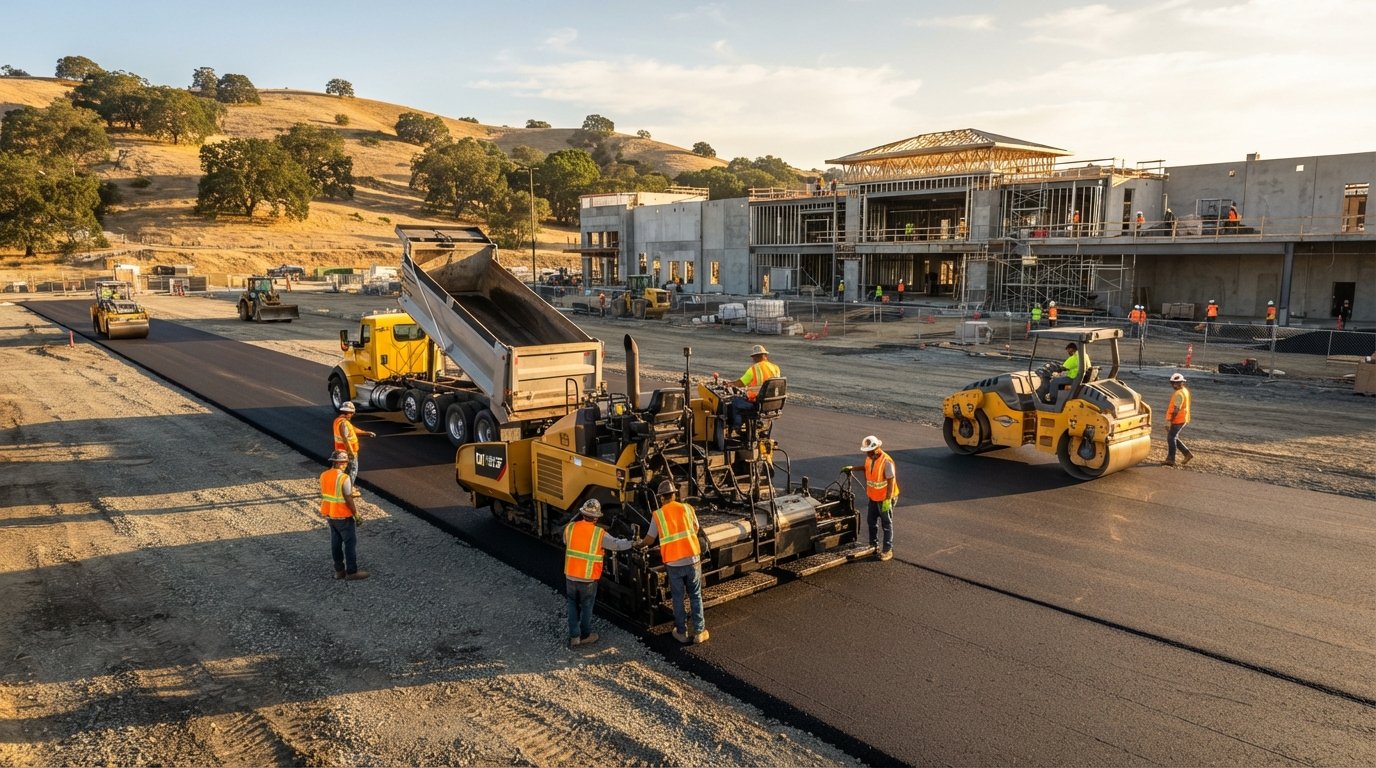
Asphalt paving is a time-sensitive operation. The mix arrives from the plant at a specific temperature, typically between 275 and 325 degrees Fahrenheit for hot mix asphalt. If it cools too much before compaction, it becomes stiff and difficult to achieve proper density. The paving crew must coordinate trucks, the paver, and rollers to maintain a continuous operation.
The binder course is placed first. It is typically thicker and contains larger aggregate, providing structural strength. The surface course is placed on top, using a finer mix that offers a smooth ride and good skid resistance. Both layers are compacted with a combination of steel-wheel and pneumatic rollers to achieve the specified density.
Compaction is critical. Insufficient compaction leaves air voids that allow water and oxygen to penetrate, accelerating oxidation and cracking. Over-compaction can crush aggregate and reduce stability. Experienced crews monitor mat temperature and roller patterns to hit the sweet spot.
Joints between paving lanes and around structures (catch basins, manholes, curbs) require special attention. Poorly sealed joints are common points of water infiltration and failure. The crew should clean and tack joints before placing adjacent asphalt, and seal them properly after compaction.
Quality Control and Inspection Throughout the Process
Quality control is not a single step; it is woven through every phase of the new construction asphalt paving process for commercial lots. Developers should expect the contractor to perform and document tests at key points.
- Subgrade compaction testing: Verifies that the soil can support the pavement structure.
- Base course gradation and compaction: Ensures the aggregate meets spec and is properly densified.
- Asphalt mix temperature checks: Confirms the mix is within the acceptable range at arrival and during placement.
- Asphalt density testing: Measures the compacted density of both binder and surface courses.
- Smoothness and slope verification: Checks that water drains and the surface meets ride quality standards.
In addition to contractor testing, many jurisdictions require third-party inspection or hold points where the city or county must sign off before the next phase begins. Failing to schedule these inspections can delay the project by days or weeks. A contractor familiar with East Bay permitting processes can anticipate these requirements and keep the schedule on track.
Documentation matters for warranty purposes. If a problem arises later, having a record of proper testing and materials helps resolve disputes and supports warranty claims.
Timing and Scheduling: What to Expect
The timeline for paving a commercial lot depends on site size, complexity, weather, and permitting. A small restaurant pad might be graded and paved in a few weeks, while a large shopping center could take several months from rough grading to final striping. Understanding the sequence helps developers coordinate with other trades and set realistic expectations for tenants.
Weather is a major factor. Asphalt paving cannot be done in rain or when temperatures are too low. In the East Bay, the rainy season (typically November through March) can limit paving windows. Grading and base work can sometimes continue in light rain, but asphalt placement requires dry conditions. Scheduling paving for late spring through early fall reduces the risk of weather delays.
Permitting and inspections also affect timing. Some jurisdictions require separate permits for grading, drainage, and paving. Inspections must be requested in advance and may have limited availability. Working with a contractor who knows the local process helps avoid bottlenecks.
For projects with hard opening dates, such as a restaurant franchise, it is wise to build float into the schedule for weather and unforeseen site conditions. Rushing the paving process to meet a deadline often leads to quality compromises that cost more later.
Common Mistakes in Commercial Asphalt Paving
Even experienced developers can fall into traps when managing a paving project. Being aware of common pitfalls helps you ask the right questions and insist on proper procedures.
- Skipping or shorting the base course: Trying to save money on aggregate by reducing base thickness leads to premature failure.
- Paving over wet or soft subgrade: This traps moisture and guarantees future settling and cracking.
- Inadequate compaction: Rushing compaction or using the wrong equipment results in low density and early oxidation.
- Poor drainage design: Flat grades or insufficient slope cause water to pond, weakening the pavement.
- Ignoring joint preparation: Dirty or unsealed joints allow water infiltration and joint failure.
Each of these mistakes can be avoided with proper planning, qualified contractors, and adequate inspection. The cost of doing it right is almost always less than the cost of repairing a failed lot.
East Bay Considerations for Commercial Paving
The East Bay has its own set of conditions that affect paving projects. Soils vary from expansive clays to sandy loams, each requiring different handling. Local jurisdictions have specific requirements for stormwater treatment, erosion control, and inspection. A contractor who works regularly in the area knows these nuances and can navigate them efficiently.
DRT Grading & Paving specializes in new construction grading and asphalt paving for commercial lots, including shopping centers and restaurant sites. Their experience with projects like Chick-fil-A and Raising Cane's locations demonstrates the ability to meet the demands of national brands. For developers in the East Bay and surrounding areas, working with a local contractor means faster response times, familiarity with local regulations, and a reputation tied to the community.
If your project involves new construction or you need maintenance for an existing lot, DRT Grading & Paving offers full-service grading, paving, and asphalt maintenance. They serve HOAs, school districts, and commercial property owners throughout the East Bay. Requesting a quote early in the planning process can help you budget accurately and avoid surprises.
Understanding the new construction asphalt paving process for commercial lots empowers you to make informed decisions, ask the right questions, and ensure that your investment performs for years to come. From the first cut of the grader to the final stripe of paint, every step matters. With the right team and a clear understanding of the process, you can deliver a parking lot that serves your tenants, customers, and bottom line.