School District Parking Lot Pavement Maintenance Schedule
Build a school district parking lot pavement maintenance schedule that prevents costly repairs. Call DRT Grading & Paving at 9258629900 to get started.

By Grace Young
Learn more about asphalt maintenance for guides, costs, and what to expect.
Planning a grading or paving job?
Send the project details, a budget range, and when you want to start.
A cracked, faded parking lot is more than an eyesore at a school. It is a liability, a budget problem waiting to happen, and a daily frustration for staff, parents, and bus drivers. Most school districts do not have a pavement failure problem. They have a scheduling problem. When seal coating, crack filling, and striping get postponed year after year, small defects turn into full-depth reconstruction, and the cost curve stops being linear. A written school district parking lot pavement maintenance schedule turns that curve back in your favor.
DRT Grading & Paving works with school districts across the East Bay on asphalt maintenance for existing lots and drives, alongside new-construction grading and paving for commercial sites such as shopping centers and restaurant pads. That mix matters here. A district lot is not a retail lot. It absorbs bus traffic, drop-off congestion, delivery trucks, and years of weather, all on a fixed facilities budget that must survive public scrutiny.
Why School Lots Deteriorate Faster Than Most Districts Expect
Asphalt is a flexible pavement, which means it moves with the ground beneath it. When that ground shifts, or when water finds a path into the subbase, the surface tells you about it within a season or two. School parking lots sit on some of the hardest-working pavement in any community, and the traffic patterns are unusually punishing.
Think about a typical elementary school lot. Every weekday morning, several hundred vehicles queue in the same lane, brake in the same spot, and turn across the same corner. Buses, which weigh far more than passenger cars, follow fixed routes through the lot and often park on the same stalls day after day. Trash trucks and delivery vehicles add concentrated loads near dumpster pads and kitchen entrances. Meanwhile, the district may only repave or seal coat on a cycle measured in decades, not years.
Sun exposure compounds the problem. In the East Bay, summer heat oxidizes the asphalt binder, turning dark, flexible pavement into a brittle, gray surface. Once oxidation takes hold, the pavement loses its ability to stretch with temperature changes, and cracks begin to open. Water enters those cracks, saturates the base, and the freeze-thaw and wet-dry cycles do the rest. By the time a pothole appears, the damage has usually been developing for years.
What a Realistic Maintenance Schedule Looks Like
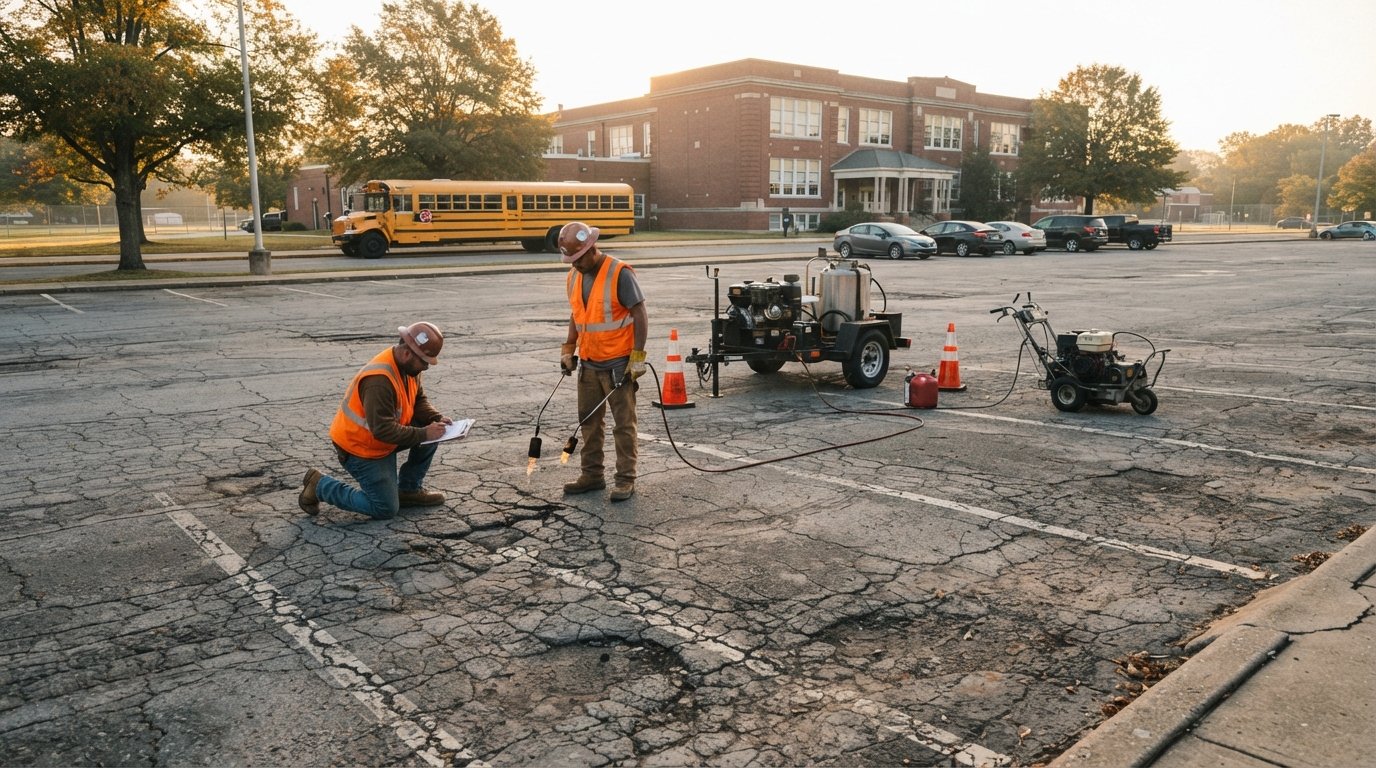
A school district parking lot pavement maintenance schedule is not a single annual event. It is a cycle of inspections, preventive treatments, and capital planning that keeps each lot in service for as long as possible before reconstruction becomes unavoidable. The most effective schedules combine routine observation by district staff with periodic professional assessments.
The cycle below reflects common practice for districts managing multiple sites with limited budgets. Exact timing depends on pavement age, traffic volume, drainage, and climate, but the sequence is consistent.
- Annual walk-through inspections. Facilities staff document cracks, potholes, drainage issues, and faded striping at each lot, ideally in spring after winter weather has done its damage.
- Every 2 to 4 years: crack filling and seal coating. Cleaning and filling cracks before seal coating prevents water intrusion and extends the life of the surface.
- Every 4 to 8 years: re-striping and layout review. Restripe to restore visibility and update layouts for current traffic patterns, ADA requirements, and bus routing.
- Every 8 to 15 years: mill and overlay. When surface deterioration is widespread but the base is still sound, milling off the top layer and placing new asphalt restores the lot at a fraction of full reconstruction cost.
- As needed: full-depth repair or reconstruction. Reserved for areas with failed base, severe alligator cracking, or chronic drainage problems.
The intervals above are guidelines, not rules. A lot with heavy bus traffic or poor drainage may need crack filling every year. A lightly used overflow lot may stretch to five or six years between seal coats. The point of a schedule is to make those decisions deliberately, based on condition data, rather than reacting after a parent complains or a trip-and-fall claim lands on the risk manager's desk.
Building the Schedule Around the School Calendar
Timing is where school district maintenance differs most from commercial property maintenance. You cannot seal coat a lot during morning drop-off. You cannot mill and overlay a staff lot during standardized testing week. The work has to fit into windows when students, staff, and buses are not depending on the pavement.
Summer break is the obvious window, and it is the right one for large projects such as overlays, full-depth repairs, and re-striping. But summer is also the busiest season for paving contractors, so districts that wait until June to request bids often find themselves at the back of the line. The most organized districts plan major pavement work a full budget cycle ahead and award contracts in late winter or early spring.
Smaller tasks fit into shorter windows. Crack filling and seal coating can sometimes be completed over a long weekend, a Thanksgiving break, or a spring recess, provided the weather cooperates and the material has time to cure. Striping is often best done during a break as well, since fresh paint needs dry conditions and a few hours without traffic.
DRT Grading & Paving schedules school district work around these windows and coordinates directly with facilities directors so that no lot is out of service longer than necessary. For districts in the East Bay, that local presence matters. A contractor who knows the area's weather patterns and inspection cycles can help you pick dates that actually hold.
Preventive Treatments That Stretch Your Budget
The financial case for preventive maintenance is straightforward. Seal coating and crack filling cost a small fraction of what reconstruction costs per square foot, and they add years of service life when applied before the pavement fails. Districts that skip these steps often end up paying three to five times more per square foot later.
There is a second, less obvious benefit: predictable budgeting. When you maintain on a schedule, you know roughly what each lot will need and when. That lets you spread work across multiple fiscal years instead of absorbing a surprise six-figure repair in a single budget cycle. School boards and bond oversight committees respond better to a documented maintenance plan than to an emergency purchase order.
Safety is the third benefit, and it may be the most important. Cracked and heaved pavement creates trip hazards. Faded striping confuses drivers in drop-off zones. Potholes damage buses and can throw a bicyclist or pedestrian. A maintained lot is a safer lot, and documented maintenance is a strong defense if a claim ever arises.
How to Prioritize When the Budget Will Not Cover Everything
Most districts cannot treat every lot in the same year. Prioritization is unavoidable, and it should be based on condition and risk rather than on which site complains the loudest.
A simple ranking framework helps. Score each lot on structural condition, drainage, traffic volume, and visibility to the public. Lots with failing base, standing water, or heavy bus traffic move to the top. Lots that are cosmetically worn but structurally sound can wait a year or two with crack filling in the meantime.
- High priority: Failed base, alligator cracking, potholes, drainage problems, or heavy bus and delivery traffic.
- Medium priority: Widespread surface cracking, oxidation, or faded striping in active lots.
- Lower priority: Lightly used overflow or storage lots with cosmetic wear only.
- Watch list: Lots approaching the end of their seal coat cycle that need inspection before the next budget request.
This kind of scoring also gives facilities directors something concrete to bring to the board. Instead of asking for money to "fix the parking lots," you can present a ranked list with estimated costs and consequences of delay. That is a much easier request to approve.
Working With a Contractor Who Understands Districts
Not every paving company is set up to work with school districts. District projects involve bid processes, insurance requirements, background checks for workers on campus, and coordination with multiple departments. A contractor who has done this before will anticipate those requirements rather than discover them mid-project.
DRT Grading & Paving handles asphalt maintenance for school districts, HOAs, and similar property owners in the East Bay, in addition to new-construction grading and paving for commercial sites such as shopping centers and restaurant pads. That range of experience is useful because it means the same crew that understands tight construction schedules also understands the constraints of working on an active campus.
When you request a quote, ask for a condition assessment as part of the proposal. A good contractor will walk the lots, identify the failure modes, and recommend a treatment plan that matches your budget and your calendar. That assessment becomes the backbone of your school district parking lot pavement maintenance schedule.
Getting Started on a Schedule This Year
You do not need a perfect plan to start. You need a first step. Walk your lots this spring, take photos, and note where cracks, potholes, and drainage problems are appearing. Then bring in a paving contractor to review your findings and help you build a multi-year plan.
From there, the schedule largely runs itself. Inspect annually. Fill cracks and seal coat on cycle. Restripe as needed. Plan overlays before the base fails. Prioritize based on condition and risk. Fund the work predictably instead of reactively.
Districts in the East Bay that follow this approach consistently spend less per square foot over time, keep their lots safer, and avoid the emergency repairs that wreck a facilities budget. If you are ready to build a maintenance schedule for your school district, contact DRT Grading & Paving at 9258629900 or request a quote online. A short assessment now can save your district a great deal of money and disruption later.