School Parking Lot Safety and Pavement Condition
A safe school lot starts with solid asphalt. Call 9258629900 for school parking lot safety and pavement condition help in the East Bay.

By Grace Young
Learn more about asphalt maintenance for guides, costs, and what to expect.
Planning a grading or paving job?
Send the project details, a budget range, and when you want to start.
A cracked, uneven school parking lot is more than an eyesore. It is a daily liability that puts students, parents, staff, and buses at risk before the first bell even rings. Every drop-off, every pickup, and every afternoon bus departure depends on pavement that holds up under heavy traffic and changing weather. When asphalt starts to fail, safety declines quietly at first, then all at once. Understanding how pavement condition directly affects school parking lot safety is the first step toward protecting your district, your budget, and the families you serve.
Why School Parking Lot Safety Depends on Pavement Condition
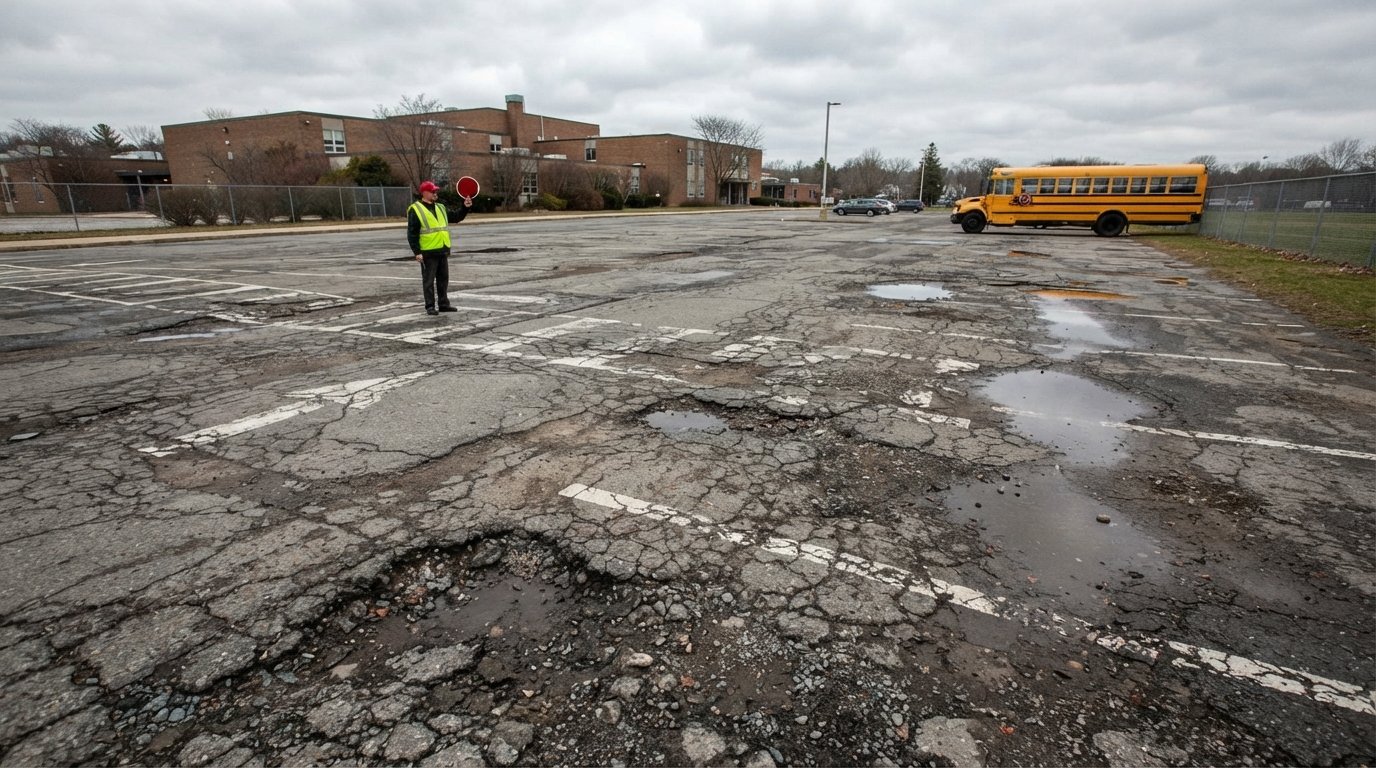
Parking lots at schools face a level of wear that few other properties experience. A typical elementary school may see hundreds of vehicles pass through a single drop-off window. Buses, delivery trucks, and maintenance vehicles add concentrated weight in specific zones. Over time, that traffic pattern creates ruts, depressions, and surface breaks that catch tires, trip pedestrians, and accelerate further damage.
Pavement condition is not just about appearance. It is the physical foundation that keeps traffic flowing in predictable patterns. When asphalt is smooth and intact, painted lines stay visible, drainage works as designed, and pedestrians can trust the surface beneath them. When it deteriorates, every one of those assumptions breaks down.
School districts in the East Bay face additional pressure from seasonal rain, which seeps into cracks and weakens the subgrade. A small fissure in October can become a pothole by January and a trip-and-fall claim by spring. That is why school parking lot safety and pavement condition should be treated as a single, connected priority rather than two separate maintenance items.
Common Pavement Problems That Create Safety Hazards
Most parking lot injuries and vehicle damage do not come from dramatic failures. They come from small, predictable defects that were visible months earlier. Knowing what to look for helps districts and property managers act before a minor repair becomes a major safety event.
Here are the most common pavement problems found in school lots:
- Cracking: Hairline cracks let water in, and freeze-thaw cycles or heavy traffic widen them into structural breaks.
- Potholes: These form when water penetrates the base layer and traffic dislodges the asphalt surface, creating sudden, dangerous depressions.
- Alligator cracking: A web-like pattern that signals the subbase is failing, often in bus lanes and drop-off zones.
- Rutting and depressions: Low spots that collect water and cause vehicles to drift, especially during rainy pickups.
- Faded striping and missing signage: Without clear lane markings, crosswalks, and stop bars, pedestrian and vehicle paths intersect unpredictably.
Each of these issues carries a specific safety consequence. A pothole near a crosswalk can cause a driver to swerve into a pedestrian lane. Faded striping at a bus loading zone can lead to confusion during the busiest ten minutes of the school day. Alligator cracking in a fire lane may prevent emergency vehicles from accessing the campus. These are not hypothetical risks. They are the everyday reality of deferred pavement maintenance.
How Pavement Condition Affects Drop-Off and Pickup Zones
Drop-off and pickup zones are the most safety-critical areas of any school parking lot. They concentrate pedestrians, vehicles, and buses into a small footprint during narrow time windows. Pavement condition in these zones determines whether traffic flows smoothly or creates conflict points.
When asphalt is smooth and well-marked, drivers follow predictable paths. Parents know where to stop, students know where to walk, and staff can supervise effectively. When the surface is broken or the markings are worn, drivers improvise. They stop in crosswalks, cut across lanes, or park in fire lanes. Each improvisation increases the chance of a collision or a pedestrian injury.
Bus loading zones deserve special attention. Buses are heavy, and they stop in the same spot dozens of times per day. That repeated loading can cause asphalt to shove and deform, creating uneven surfaces where students step off the bus. A single misstep at a bus door can lead to a serious injury, and the district may be held responsible if the pavement was known to be defective.
For these reasons, school parking lot safety and pavement condition should be reviewed together whenever a district plans traffic flow changes, enrollment growth, or new bell schedules. A pavement assessment can reveal whether the lot can support the traffic pattern the school intends to use.
Liability and Financial Risks of Deferred Maintenance
School districts and property owners often delay pavement maintenance because budgets are tight and the damage seems cosmetic. That calculation changes quickly when an injury occurs or when a vehicle is damaged by a pothole. Liability claims, legal fees, and emergency repairs can cost far more than a planned maintenance program.
Beyond liability, deferred maintenance accelerates deterioration. A crack that could be sealed for a modest cost can become a full-depth repair or an asphalt overlay within a few seasons. A parking lot that could have been preserved with sealcoating and patching may need reconstruction years earlier than necessary. That is not just a safety issue. It is a budget issue that affects every program the district funds.
Insurance carriers also pay attention to pavement condition. Districts with documented maintenance programs and current pavement assessments are often better positioned when claims arise. A clear record of inspections, repairs, and safety improvements demonstrates that the district took reasonable steps to protect students and visitors.
For East Bay school districts, HOAs, and commercial property owners, the most cost-effective approach is to schedule regular pavement evaluations and act on the findings before small defects become large liabilities. DRT Grading & Paving provides asphalt maintenance for school districts and similar properties, helping owners preserve both safety and budget.
Key Elements of a School Parking Lot Safety Inspection
A useful safety inspection goes beyond a quick visual scan. It should evaluate both the pavement surface and the way people use the lot. The goal is to identify hazards, prioritize repairs, and document conditions for planning and insurance purposes.
A thorough inspection typically covers the following areas:
- Surface condition: Cracks, potholes, rutting, depressions, and areas of standing water.
- Striping and signage: Visibility of crosswalks, stop bars, lane lines, fire lanes, and accessible parking spaces.
- Drainage: Whether water flows away from pedestrian areas and does not pool in drop-off or bus zones.
- Traffic flow: Whether vehicle paths, pedestrian paths, and bus routes intersect in unsafe ways.
- Accessibility: Condition of curb ramps, accessible routes, and parking spaces for people with disabilities.
After the inspection, findings should be ranked by safety risk and repair cost. High-risk items, such as potholes in crosswalks or broken asphalt at bus doors, should be addressed immediately. Lower-risk items can be scheduled into a maintenance plan that spreads costs across the fiscal year.
Documenting the inspection with photos, notes, and dates creates a record that supports budget requests and demonstrates due diligence. It also helps districts track whether conditions are improving or declining over time.
Building a Pavement Maintenance Plan for Schools
The most effective way to protect school parking lot safety and pavement condition is to move from reactive repairs to a planned maintenance program. Reactive maintenance waits for something to break. Planned maintenance prevents failures before they happen.
A practical program includes several layers of care. Sealcoating protects the asphalt surface from oxidation, water, and chemical spills. Crack sealing keeps water out of the base layers. Patching addresses localized failures before they spread. Striping restores the visual cues that guide traffic and pedestrians. When these treatments are combined on a schedule, they extend the life of the pavement and reduce the frequency of major repairs.
Timing matters as much as the treatments themselves. In the East Bay, the best window for many asphalt maintenance tasks is the dry season, when temperatures and moisture levels support proper curing. Scheduling work during summer break or other low-traffic periods minimizes disruption to school operations.
Districts should also plan for the long term. A pavement management plan might cover five to ten years and include regular inspections, prioritized repairs, and budget projections. That kind of planning helps districts avoid emergency spending and demonstrates responsible stewardship of public funds.
Choosing the Right Pavement Partner for School Properties
Not every paving contractor understands the specific demands of school properties. Schools have unique traffic patterns, strict safety expectations, and limited windows for construction. A contractor who works primarily on residential driveways may not have the experience to handle a bus loop or a crowded drop-off zone.
DRT Grading & Paving specializes in commercial and institutional paving, including asphalt maintenance for school districts and HOAs in the East Bay. The company also handles new construction grading and paving for shopping centers and restaurant sites, which means it understands how to build pavement that performs under heavy, repeated traffic.
When evaluating a pavement partner, districts and property managers should look for several qualities:
- Experience with school and institutional properties: Familiarity with bus zones, drop-off loops, and accessibility requirements.
- Clear communication: The ability to explain findings, prioritize repairs, and coordinate around school schedules.
- Comprehensive services: Grading, paving, and maintenance capabilities under one contract.
- Local knowledge: Understanding of East Bay weather, soil, and regulatory conditions.
- Documentation: Written assessments, photos, and records that support budget and insurance needs.
A strong partner will also help districts think beyond the current repair. They will identify underlying causes, such as poor drainage or inadequate base thickness, and recommend solutions that prevent the same problem from returning.
Steps to Improve Safety and Pavement Condition This Year
Districts and property owners who want to make progress this year can follow a straightforward sequence. The key is to start with assessment, then move to action, then build a plan for ongoing care.
First, schedule a professional pavement inspection that covers both safety and structural condition. Second, prioritize repairs based on risk, addressing the most dangerous defects first. Third, complete routine maintenance such as crack sealing and striping to protect the surface and restore visual guidance. Fourth, document everything and use that record to build a multi-year maintenance plan.
These steps do not require a complete reconstruction. In many cases, targeted repairs and timely maintenance can restore safety and extend pavement life for years. The important thing is to start before the next rainy season turns small defects into large hazards.
School parking lot safety and pavement condition are inseparable. A safe lot is one that is inspected, maintained, and repaired on a schedule. A failing lot is one that is ignored until an injury or a lawsuit forces action. By treating pavement as a safety asset, schools and property owners protect the people who depend on them every day.
DRT Grading & Paving helps school districts, HOAs, and commercial property owners in the East Bay maintain safe, durable asphalt. From new construction grading and paving to ongoing asphalt maintenance, the team brings practical experience to every project. To request an assessment or a quote, call 9258629900 or visit the get a quote page.