Site Grading for Shopping Center Development in the East Bay
Site grading for shopping center development in the East Bay sets the foundation for lasting pavement. Call 9258629900 for expert grading and paving.

By Yara Walsh
Learn more about grading for guides, costs, and what to expect.
Planning a grading or paving job?
Send the project details, a budget range, and when you want to start.
A shopping center lives or dies by what happens before the first tenant ever unlocks a door. Long before the signage goes up or the parking stalls get striped, a crew with lasers, GPS-guided blades, and compactors is quietly deciding whether that center will drain properly for the next thirty years or turn into a pond every January. Site grading for shopping center development in the East Bay sits at the very front of that chain. Get it right, and everything downstream (paving, utilities, inspections, tenant build-outs) moves faster and costs less. Get it wrong, and you spend the next decade chasing settlement cracks, ponding water, and angry tenants.
This guide walks developers, general contractors, and property owners through what site grading actually involves on a commercial retail project in the East Bay, why local conditions make it different from grading almost anywhere else in California, and how to sequence the work so your shopping center opens on schedule. DRT Grading & Paving handles this exact scope, from ground-up grading and asphalt for new shopping centers and restaurant pads to long-term maintenance for the properties once they are open.
What Site Grading Means on a Commercial Retail Project
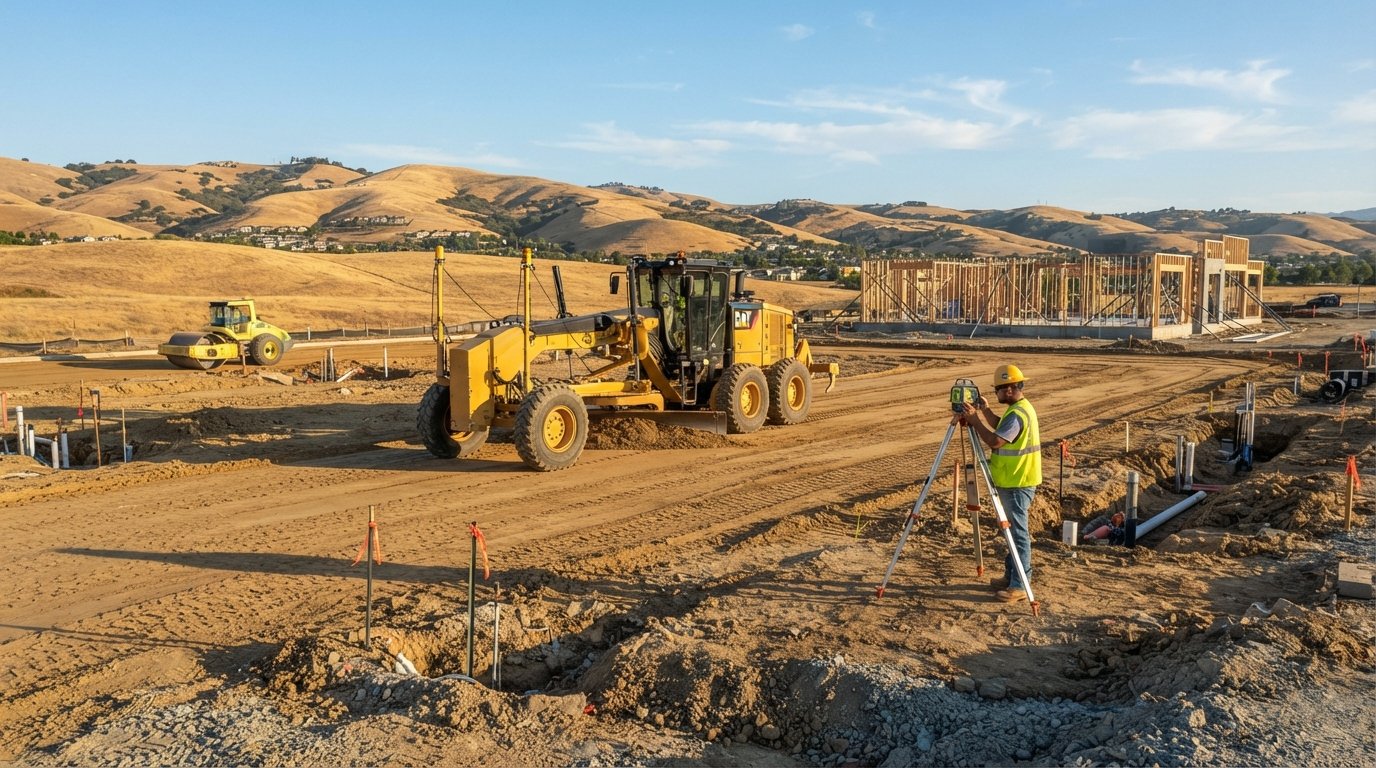
Site grading is the controlled reshaping of a piece of land so it can support the structures, pavement, and drainage a shopping center requires. On a residential lot, grading might be a few hundred cubic yards of cut and fill. On a retail center with 40,000 square feet of building area and 200 parking stalls, grading can move tens of thousands of cubic yards, and every inch of elevation matters because it determines how stormwater behaves across the entire site.
The work generally breaks into three overlapping phases. Rough grading establishes the overall elevations and drainage patterns. Fine grading tightens those elevations to within a fraction of a foot so paving and flatwork can proceed. Utility and structural grading happens around footings, underground detention systems, and trench work, and it has to be coordinated tightly with the paving schedule so freshly compacted subgrade does not get torn up by a late water line.
For a shopping center specifically, grading has to solve several problems at once. The parking field must drain to inlets or bioretention areas without sending water into tenant entries. The building pad must sit at an elevation that keeps finished floor above the surrounding pavement and above the local floodplain requirement. Loading zones, trash enclosures, and drive-through lanes (common on restaurant pads like Chick-fil-A or Raising Cane's sites) each impose their own slope limits. A grader who treats the whole site as one flat plane will fail inspection and, worse, fail the tenants.
Why East Bay Sites Are Not Like Other California Sites
The East Bay sits in a geologically active, climatically unusual pocket of California. Grading contractors working here deal with shrink-swell clay soils in parts of the Tri-Valley, expansive adobe and bay mud closer to the shoreline, and hillside cuts in the Berkeley and Oakland hills that require careful benching and slope stability analysis. Each of these soil types behaves differently under moisture change, and each demands a different approach to compaction, import, and drainage design.
Seasonal timing is just as important. The East Bay gets the bulk of its rain between November and March, and many jurisdictions restrict earthwork during the rainy season unless the contractor has an approved winterization plan. That means a developer targeting a fall grand opening needs grading finished and stabilized well before the first storms, or the project absorbs months of delay. Contractors who know the local inspection calendars and stormwater rules can compress the schedule in ways an out-of-area crew simply cannot.
There is also the question of what is already underground. East Bay commercial sites frequently sit on former orchards, rail spurs, or older retail pads, which means buried debris, abandoned utilities, and undocumented fill. A grading plan that assumes clean native soil will blow its budget in the first week. Local experience matters here more than almost anywhere else in the state.
The Site Grading Process, Step by Step
A well-run shopping center grading project follows a predictable sequence. The details vary by site, but the order rarely does. Here is how a typical East Bay retail project moves from raw dirt to a pad ready for asphalt.
- Survey and existing conditions review. The grading contractor verifies the topographic survey, checks for discrepancies against the civil plans, and identifies any undocumented fill, debris, or utilities that will affect earthwork quantities.
- Clearing, grubbing, and demolition. Vegetation, old pavement, foundations, and underground tanks come out. On redevelopment sites, this phase can be a project of its own.
- Rough grading and mass excavation. The site is cut and filled to the design elevations, with soil placed in lifts and compacted to the geotechnical engineer's specification. Drainage swales and detention areas take shape during this phase.
- Utility trenching and backfill. Storm drain, sewer, water, and dry utilities go in, then get backfilled and compacted so the pavement subgrade is not compromised later.
- Fine grading and subgrade preparation. Final elevations are set to within a few hundredths of a foot, the subgrade is proof-rolled, and any soft spots are remediated before paving begins.
Each step depends on the one before it. Skipping proof-rolling to save a day, for example, is one of the most common causes of premature asphalt failure on retail sites. The pavement looks fine for a year or two, then rutting and alligator cracking appear exactly where the subgrade was weak, and the repair cost dwarfs whatever was saved during grading.
How Grading Sets Up the Asphalt and the Long-Term Life of the Center
Asphalt is only as good as the base beneath it. A shopping center parking lot typically consists of compacted subgrade, an aggregate base layer, and then the asphalt itself, and the grading contractor is responsible for the first two. If the subgrade drains poorly or the base is not uniformly compacted, the asphalt will fail regardless of how good the mix design is. This is why grading and paving should be performed by the same team whenever possible. Handoffs between separate contractors are where accountability gets fuzzy and problems get buried.
Drainage is the other long-term factor. A parking field graded at a consistent two percent slope toward inlets will shed water quickly and dry after storms. A field with flat spots, reverse slopes, or ponding areas will hold water, and standing water is the single fastest way to destroy asphalt. It softens the base, accelerates oxidation, and creates potholes that grow every winter. Developers who invest in precise grading during construction spend far less on maintenance over the life of the center.
That maintenance relationship continues after opening. Once a center is built, the owner or HOA needs a partner who can handle seal coating, crack filling, and pavement repairs without shutting down tenant access for days. DRT Grading & Paving supports both sides of that lifecycle: new-construction grading and asphalt for shopping centers and restaurant pads, and ongoing asphalt maintenance for the properties once they are operational.
Permits, Inspections, and East Bay Regulatory Realities
Grading on a commercial site in the East Bay is a permitted activity, and the permit conditions drive much of the schedule. Most jurisdictions require a grading permit supported by a geotechnical report, a stormwater pollution prevention plan, and a drainage study. Inspectors from the city or county verify compaction, elevation, and erosion control at defined hold points, and work cannot proceed past those points until sign-off is granted.
Stormwater compliance is a major piece of the puzzle. The regional water quality board requires construction sites to control sediment, and East Bay cities enforce those rules strictly. A grading contractor who is not current on best management practices will get the site red-tagged, which stops everything. The good news is that a contractor who works in the region regularly already knows the local inspectors, the common plan check comments, and the seasonal restrictions, which translates directly into fewer delays for the developer.
Building pad certification is another milestone worth planning around. The geotechnical engineer has to certify that the pad meets the design bearing capacity before the structural work can begin, and that certification depends entirely on how well the grading was executed and documented. Clean, well-organized grading records make that certification a formality rather than a fight.
Working With a Local East Bay Grading and Paving Partner
Choosing the right contractor for site grading on a shopping center is a decision that echoes through the entire project. The lowest bid is rarely the cheapest outcome, because grading errors do not show up immediately. They show up as settlement, drainage complaints, and repaving costs two or three years down the road, long after the contractor has been paid and left.
A local East Bay contractor brings three concrete advantages. First, soil and site knowledge: familiarity with the clays, fills, and hillside conditions that define the region. Second, regulatory fluency: knowing how local agencies review grading permits and what they expect at each inspection. Third, a maintenance relationship that continues after construction, so the same team that built the lot can keep it in service for years.
DRT Grading & Paving focuses on exactly this combination. The company handles new-construction grading and asphalt for shopping centers and restaurant sites, including recognizable projects like Chick-fil-A and Raising Cane's locations, and provides asphalt maintenance for HOAs, school districts, and other property owners across the East Bay. Developers who want one accountable team from raw dirt to finished parking lot, and a partner who stays involved after opening day, can reach the team directly through the company's quote page or by phone.
A shopping center is a long-term asset, and the grading underneath it is the foundation of that asset's value. Getting it right the first time, with a contractor who knows the East Bay, is the most reliable way to protect the investment.