
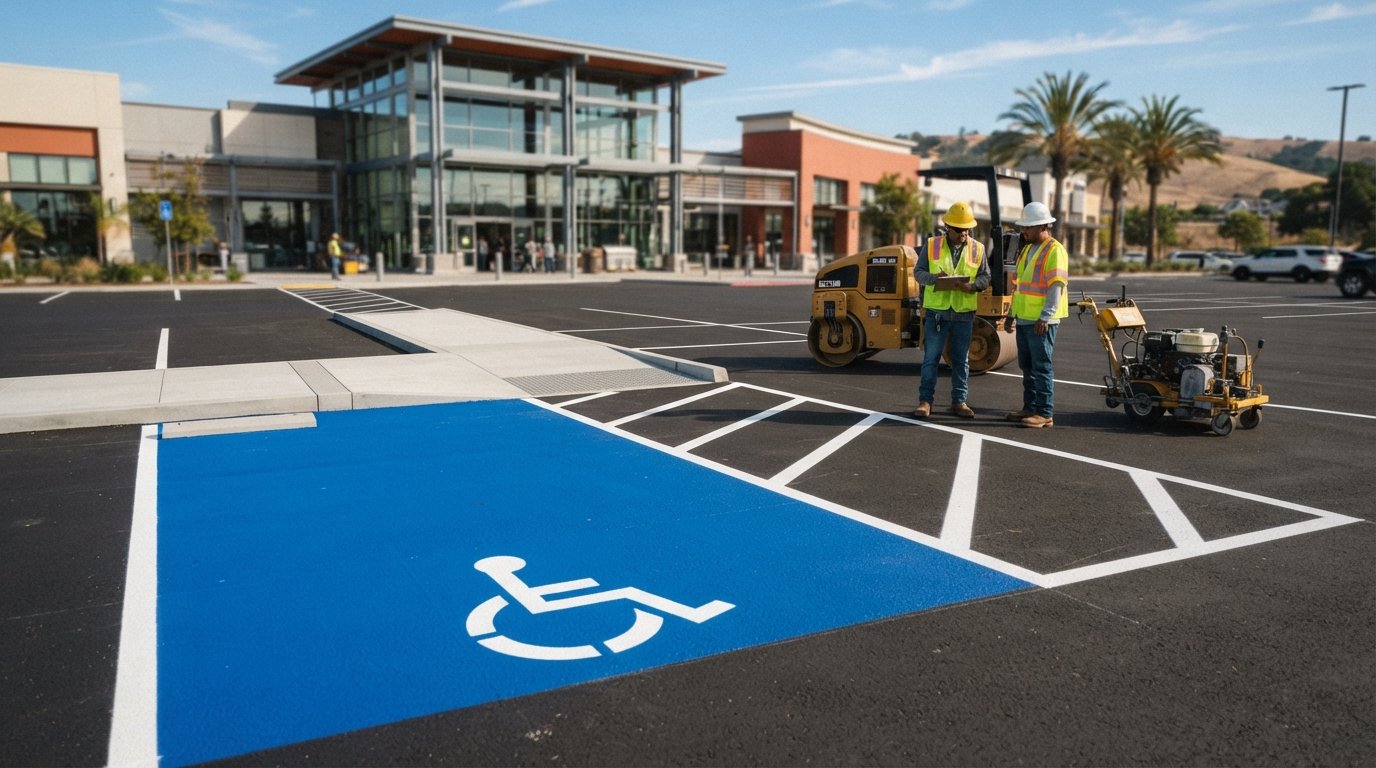
ADA Parking Lot Compliance for East Bay Commercial Property
Keep your East Bay commercial lot compliant and avoid costly fines. Call 9258629900 for ADA parking lot compliance and asphalt maintenance.

Learn more about asphalt maintenance for guides, costs, and what to expect.
Planning a grading or paving job?
Send the project details, a budget range, and when you want to start.
A single faded accessible stall stripe can expose an East Bay commercial property owner to thousands of dollars in fines, a civil lawsuit, or both. California leads the nation in ADA parking litigation, and East Bay cities like Oakland, Fremont, Walnut Creek, and Concord actively enforce accessibility standards during routine inspections and permit reviews. For shopping center owners, restaurant developers, HOAs, and school districts, ADA parking lot compliance is not a box to check once at construction. It is an ongoing obligation tied to the asphalt surface itself, and it belongs in every paving and maintenance budget.
This guide breaks down what ADA compliance actually requires in a parking lot, how it intersects with California law, why East Bay properties face heightened scrutiny, and how working with a local grading and paving contractor keeps your lot compliant from the first grade stake to the final re-stripe.
What ADA Parking Lot Compliance Actually Requires
The Americans with Disabilities Act sets the federal baseline for accessible parking, and the 2010 ADA Standards for Accessible Design spell out the specifics that apply to parking facilities. The core requirements cover stall counts, dimensions, signage, access aisles, and the path a person travels from a vehicle to a building entrance. A lot can have the right number of blue signs and still fail compliance because the access aisle slopes the wrong way or the route to the door crosses a broken curb ramp.
At the federal level, the rules most commonly cited during inspections and lawsuits include these elements:
- Stall counts: one accessible stall for lots with 1 to 25 total stalls, then a sliding scale that requires van-accessible spaces as lots grow larger.
- Van-accessible stalls: a minimum 132-inch-wide space or a standard stall paired with a 96-inch access aisle, clearly signed as van accessible.
- Signage: signs mounted high enough to be visible over a parked vehicle, with the international symbol of accessibility and the van-accessible designation where required.
- Access aisles: striped, marked aisles adjacent to each accessible stall, kept free of carts, cones, and snow or debris.
- Surface condition: stalls, aisles, and routes that are stable, firm, and slip resistant, which means cracked, heaved, or crumbling asphalt can itself be a violation.
That last point is where paving and compliance intersect. Asphalt that has settled, rutted, or cracked around a drain or utility trench can create a slope or trip hazard that takes an otherwise compliant stall out of compliance. Property managers who treat ADA issues as purely a striping or signage problem often miss the structural causes underneath the paint.
California adds its own layer on top of the federal rules. The California Building Code, the Unruh Civil Rights Act, and the Disabled Persons Act give plaintiffs strong tools to pursue claims, and state law allows statutory damages per violation in many cases. That combination is why California consistently ranks at or near the top for ADA parking-related lawsuits nationwide, and why East Bay property owners cannot afford to treat compliance as a low-priority line item.
Why East Bay Commercial Properties Face Extra Scrutiny
The East Bay has a dense mix of older shopping centers, neighborhood retail strips, restaurant pads, school campuses, and HOA communities, many of them built decades before the current ADA standards took effect. Older asphalt surfaces in cities like Oakland, Hayward, Richmond, and San Leandro have had years to settle, crack, and drain poorly, which means their accessible stalls and routes are more likely to drift out of compliance over time.
Local enforcement varies by jurisdiction, but the pattern is consistent. Cities review accessibility during business license renewals, building permits, tenant improvement projects, and code enforcement sweeps. A new restaurant build-out or a shopping center remodel almost always triggers a fresh look at the parking lot, and any resurfacing or re-striping project is expected to bring the lot up to current standards rather than simply replicate the old layout.
There is also a practical, non-legal reason East Bay owners should care. Accessible parking is how a significant share of customers, students, and residents actually reach your building. A restaurant with a compliant van-accessible stall near the entrance serves more guests. A school district with properly marked drop-off and accessible routes moves students more safely. A shopping center that maintains its accessible stalls protects its tenants and its reputation, not just its legal exposure.
For developers starting ground-up projects, compliance is easier and cheaper to get right during the initial grading and paving phase. For owners of existing properties, the work is ongoing maintenance: keeping the surface sound, the paint fresh, and the layout current as standards and local interpretations evolve.
How Asphalt Condition Drives Compliance Problems
Most ADA violations found in East Bay parking lots are not the result of someone ignoring the rules. They are the result of asphalt aging in ways that quietly break compliance. Understanding those failure modes helps property managers catch problems before an inspector or attorney does.
Common asphalt-driven compliance failures include:
- Cross-slope creep: accessible stalls and access aisles must stay within a maximum cross slope, and settled or heaved asphalt can push a stall past that limit even when the original design was correct.
- Faded striping: access aisles and stall boundaries that have worn away make it impossible to tell whether the required clear space exists, and enforcement treats missing striping as a violation.
- Cracked and raveled surfaces: crumbling asphalt at the edge of an accessible stall creates an unstable surface, which fails the firm and stable requirement.
- Blocked access aisles: poor drainage or debris accumulation in low spots can leave standing water or sediment in the aisle, effectively blocking it.
- Damaged curb ramps and routes: the path from an accessible stall to the building entrance often crosses asphalt that has settled at a curb ramp or gutter, creating a trip hazard.
These problems tend to appear together. A lot that has not been sealcoated or re-striped in several years usually has multiple small compliance gaps at once, and fixing them properly requires more than a paint touch-up. It requires evaluating the surface, correcting any structural defects, and then restoring the layout to current standards.
For East Bay HOAs and school districts, the timeline matters too. Budgets are set annually, and unexpected ADA repairs mid-year can force difficult trade-offs. Scheduling pavement maintenance on a regular cycle, rather than reacting to complaints or citations, spreads the cost and keeps the lot compliant year round.
New Construction: Getting ADA Right From the Grade Up
For developers building new shopping centers, restaurant pads, and other commercial sites in the East Bay, ADA parking compliance starts long before the first load of asphalt arrives. It starts with grading. The slope of the subgrade, the placement of drainage, and the elevation of the building pad all determine whether the finished lot can meet accessible stall and route requirements without awkward fixes later.
A grading and paving contractor who understands ADA requirements will coordinate three things during the site work phase:
- Subgrade preparation: compacting and shaping the base so the finished asphalt can hold the required slopes across accessible stalls, aisles, and routes without ponding or drainage conflicts.
- Layout coordination: confirming stall counts, van-accessible locations, and access aisle placement against the approved site plan before paving, so striping and signage match what was permitted.
- Surface tolerances: paving to tolerances that keep cross slopes within ADA limits, especially near building entrances, curb ramps, and pedestrian routes.
Getting this right during construction is dramatically cheaper than correcting it after the lot is striped and open. A restaurant pad that opens with a compliant, well-drained lot avoids the cycle of complaints, re-striping, and potential claims that plagues properties where accessibility was treated as an afterthought.
This is work DRT Grading & Paving handles regularly for East Bay commercial clients, including new-construction grading and paving for restaurant sites and shopping centers. Their crews prepare the ground before asphalt goes down, which is exactly the stage where ADA slope and layout decisions are locked in. Developers who bring their paving contractor into the ADA conversation early avoid expensive redesigns later.
Maintenance: Keeping Existing Lots Compliant Over Time
For property owners with existing pavement, ADA compliance is a maintenance discipline. The good news is that the same work that keeps asphalt healthy also keeps the lot compliant: sealcoating, crack filling, patching, re-striping, and timely repairs. The key is doing that work on a schedule rather than waiting for a failure.
A practical compliance-focused maintenance plan for an East Bay commercial lot looks like this:
- Annual inspection: walk the lot and document the condition of accessible stalls, access aisles, signage, and the route to each entrance, noting cracks, settlement, and faded paint.
- Sealcoating every 2 to 3 years: protects the surface from oxidation and water intrusion, which slows the settling and cracking that undermine compliance.
- Crack filling and patching as needed: addresses defects before they spread into accessible stalls and routes.
- Re-striping after every sealcoat or major repair: restores stall lines, access aisles, and symbols to clear, compliant condition.
- Corrective work when standards or layouts change: adds or reconfigures van-accessible stalls, updates signage, and fixes slopes when a renovation triggers compliance updates.
HOAs and school districts in the East Bay often find this cycle easier to manage with a single contractor who handles both the asphalt work and the striping, because the layout is verified as part of the same project. Splitting the work between a paving company and a separate striping vendor creates gaps where nobody owns the final compliance check.
DRT Grading & Paving provides asphalt maintenance for HOAs, school districts, and other East Bay property owners, covering the repair and upkeep work that keeps parking lots and drives in service. For property managers juggling multiple sites, a consistent maintenance partner also makes budgeting predictable, since the same scope of work can be planned and priced across the portfolio.
Avoiding Common ADA Compliance Mistakes
Even well-intentioned property owners run into trouble because ADA compliance has a few counterintuitive rules. Knowing the common mistakes helps you ask better questions of your contractor and your legal counsel.
The most frequent missteps include:
- Assuming new paint equals compliance: fresh stripes on a lot with settled asphalt or blocked aisles do not fix the underlying violation.
- Copying the old layout: re-striping to match faded existing lines can preserve a non-compliant configuration if standards have changed.
- Ignoring the route to the door: compliance covers the path from the accessible stall to the building entrance, including curb ramps and walkways.
- Letting tenants block access aisles: carts, signage, and outdoor dining furniture in access aisles create violations that belong to the property owner.
- Waiting for a complaint or citation: proactive inspections and maintenance are far cheaper than defending a claim or paying fines.
None of these mistakes require bad intentions. They happen because ADA compliance in a parking lot is a moving target tied to asphalt condition, local enforcement, and evolving standards. A contractor who works on East Bay commercial lots every week sees these issues constantly and can flag them before they become expensive.
Working With an East Bay Paving Partner on Compliance
ADA parking lot compliance for East Bay commercial property works best when the paving contractor and the property owner treat it as a shared, ongoing responsibility. The owner or manager knows the site, the tenants, and the budget. The contractor knows the asphalt, the local inspection climate, and how to build or restore a lot that meets current standards.
When evaluating a paving partner for compliance-related work, look for a few specific capabilities. The contractor should be able to grade and pave new commercial sites, not just patch existing lots, because new construction is where compliance is easiest to get right. They should handle maintenance for occupied properties, including HOAs and school districts, where work has to be scheduled around tenants, students, and residents. And they should be local enough to understand how East Bay cities approach enforcement and permitting.
DRT Grading & Paving fits that profile. The company handles new-construction grading and asphalt for shopping centers and restaurant sites, along with asphalt maintenance for HOAs, school districts, and other East Bay properties. That combination means the same team that prepares the ground for a new restaurant pad can also keep an existing shopping center lot compliant through years of sealcoating, patching, and re-striping.
For developers, the value is a lot that opens compliant and stays that way. For property managers, the value is fewer surprises: no mid-year ADA emergency, no citation-driven scramble, and a maintenance plan that keeps the surface and the layout in good shape together. For HOAs and school districts, it means predictable budgets and a parking lot that serves every user safely.
If your East Bay property has not had an ADA-focused parking lot review recently, the simplest next step is a professional assessment of the surface and the layout. That review can tell you whether you are looking at routine maintenance, a re-striping project, or corrective work on slopes and stalls. Catching those issues early is almost always cheaper than addressing them after a complaint, and it protects the property, the tenants, and the people who rely on accessible parking every day.