
Asphalt Maintenance Plan for HOA Parking Lots
Build an asphalt maintenance plan for HOA parking lots that protects reserves and curb appeal. Call 9258629900 for a free East Bay assessment.

Learn more about asphalt maintenance for guides, costs, and what to expect.
Planning a grading or paving job?
Send the project details, a budget range, and when you want to start.
A cracked, faded parking lot is more than an eyesore. For an HOA, it is a liability, a budget problem, and a source of resident complaints that never seem to end. The good news is that the most expensive asphalt problems are also the most preventable. A written asphalt maintenance plan for HOA parking lots turns random patchwork into a predictable, budgeted cycle that protects property values and keeps residents happy. This guide walks board members and property managers through what a real plan looks like, what it costs to skip one, and how to build a schedule that fits your community.
Why HOAs Need a Written Asphalt Maintenance Plan
Most HOA boards inherit a parking lot and a vague sense that it should be sealed every few years. Without a written plan, maintenance becomes reactive: a resident reports a pothole, the board gets three bids, and the repair happens months later at emergency pricing. That cycle drains reserve funds and lets small defects grow into structural failures.
A written plan changes the math. Asphalt is a perishable surface. Sun, rain, and traffic slowly break down the binder that holds aggregate together. When water reaches the subgrade through cracks, the base softens and the pavement loses its ability to carry load. A $2,000 crack seal today can prevent a $40,000 full-depth repair in five years. That is not a sales pitch; it is the basic physics of pavement deterioration.
There is also a governance angle. California HOAs are expected to maintain common areas, and parking lots are almost always common area. A documented maintenance plan shows that the board is exercising its fiduciary duty, supports reserve study assumptions, and gives homeowners a clear answer when they ask why dues are what they are. When a board can point to a ten-year pavement calendar, the conversation shifts from blame to planning.
The Core Elements of an HOA Asphalt Maintenance Plan
Every effective plan covers the same handful of components, regardless of whether the lot serves 20 units or 400. The goal is to match the right treatment to the right defect at the right time. Applying the wrong treatment, like seal coating a lot with structural failures, wastes money and hides problems that will resurface within a year.
At a minimum, a plan should document pavement condition, establish treatment triggers, set a budget line, and assign responsibility. A simple framework used by many boards includes these elements:
- An inventory map of the lot showing age, surface type, and known problem zones.
- A condition assessment with photos and a simple rating for each section.
- A treatment schedule covering seal coating, crack sealing, patching, and striping.
- A reserve funding line sized to the schedule, not to whatever is left over.
- Clear assignment of who inspects, who bids, and who approves each task.
With those pieces in place, the plan becomes a working document rather than a binder that sits on a shelf. Boards can hand it to a contractor like DRT Grading & Paving and get scoped, comparable bids instead of vague proposals. It also makes it easy to spot when a bid is too cheap to be real, because the scope either matches the plan or it does not.
Step 1: Assess the Current Condition of Your Parking Lot
You cannot schedule maintenance you have not measured. A condition assessment is the foundation of the entire plan. For most HOAs, a walk-through with a clipboard, a camera, and a measuring wheel is enough to start. Note the age of the pavement if records exist, the last time it was sealed, and any areas that pond water after rain.
Pay attention to the difference between surface defects and structural defects. Surface defects, like oxidation, minor cracking, and fading, respond well to seal coating and crack sealing. Structural defects, like alligator cracking, potholes, rutting, and depressions, signal base failure and require patching or reconstruction before any surface treatment. Seal coating over alligator cracking is like painting over rot: it looks better for a season and then fails.
A simple rating system keeps the assessment objective. Many boards use a 1 to 5 scale, where 5 is new pavement and 1 is failing. Sections rated 4 or 5 are candidates for preventive maintenance. Sections rated 2 or 3 need repair plus surface treatment. Sections rated 1 need reconstruction. This rating becomes the backbone of the treatment schedule and the reserve study.
What to Document During the Walk-Through
Photos matter more than memory. Take wide shots of each lot section and close-ups of every crack, pothole, and stain. Note the location of drains, curbs, wheel stops, and striping. Mark utility covers and any areas where heavy vehicles, like trash trucks, regularly turn. Those turn zones fail first and should be inspected every year rather than every three.
Step 2: Match Treatments to Pavement Age and Condition
Asphalt maintenance is not one service; it is a sequence. Each treatment buys time and prepares the surface for the next. Skipping steps or applying them out of order shortens pavement life and inflates long-term cost.
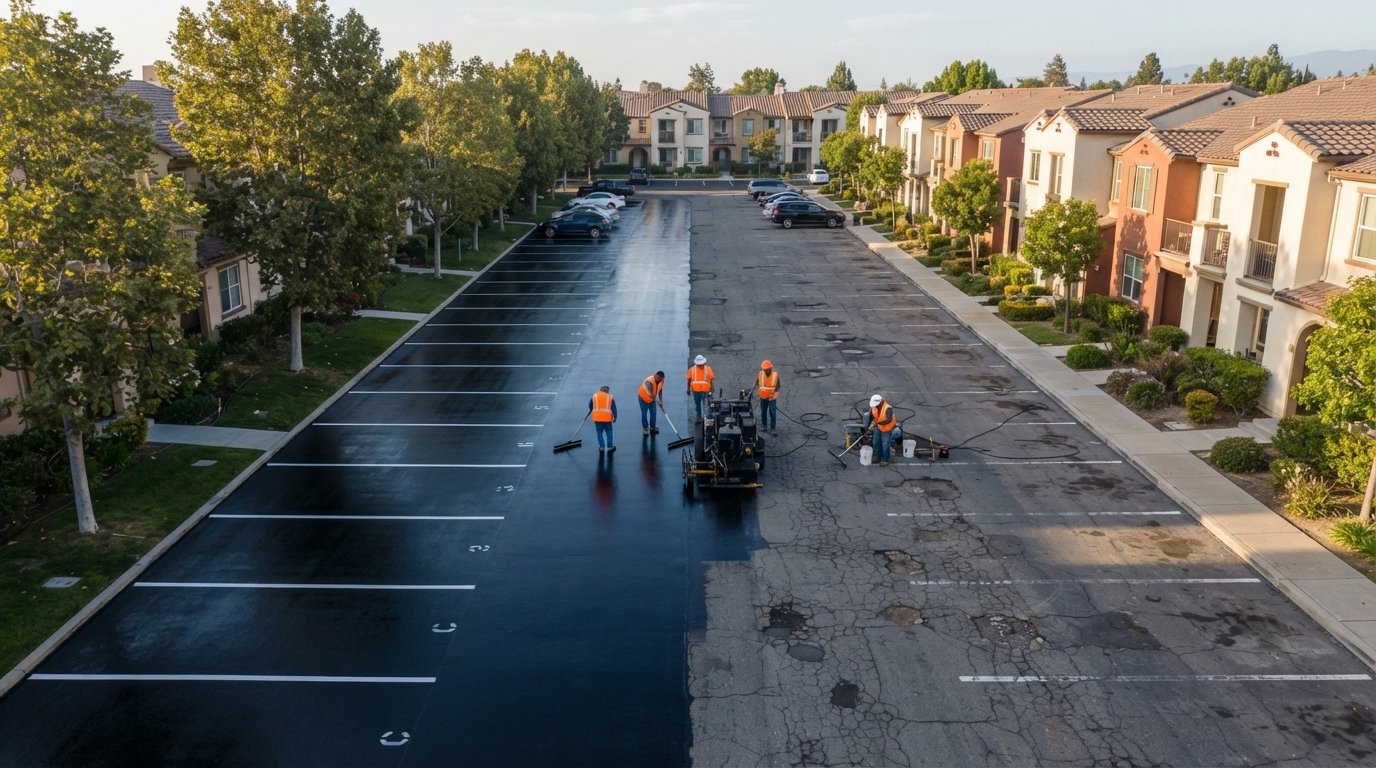
Seal coating is the most familiar treatment and the most misunderstood. It protects the surface from oxidation and water intrusion, but it does not add structural strength. Most commercial lots benefit from seal coating every two to four years, depending on sun exposure and traffic. Crack sealing should happen before seal coating so that cracks are filled and sealed rather than coated over. Patching addresses localized base failures and should be done before any surface work. Striping and wheel stop replacement typically follow seal coating, once the surface has cured.
A practical sequence for a typical HOA lot looks like this:
- Inspect and rate each section of pavement.
- Repair structural defects with patching or full-depth repair.
- Clean the surface and fill cracks with hot-pour sealant.
- Apply seal coat to sound pavement sections.
- Re-stripe stalls, fire lanes, and ADA spaces.
That sequence matters because each step protects the investment made in the previous one. Patching without crack sealing lets water back in. Seal coating without patching traps moisture under a fresh surface. Striping before seal coat cures means the paint fails early. When the plan follows this order, the lot stays in service longer and each dollar works harder.
Step 3: Build a Multi-Year Maintenance Calendar
Pavement maintenance is cyclical, not annual. A multi-year calendar spreads cost, avoids surprise special assessments, and gives contractors predictable windows to schedule work. The exact cycle depends on climate and traffic, but most East Bay HOA lots fit a pattern like this:
- Year 1: Condition assessment, crack sealing, and spot patching.
- Year 2: Seal coat and re-striping.
- Year 3: Inspection and minor repairs as needed.
- Year 4: Crack sealing and pothole patching.
- Year 5: Seal coat, re-striping, and full condition reassessment.
Lots with heavy trash truck traffic or poor drainage may need shorter intervals. Lots that are shaded and lightly used may stretch to five or six years between seal coats. The calendar should be reviewed every year and adjusted based on the latest inspection. The point is not to follow a rigid script; it is to avoid the all-too-common pattern of doing nothing for fifteen years and then facing a full reconstruction bill.
Boards should also align the calendar with the reserve study. If the reserve study assumes a seal coat every three years, the maintenance plan should match. If it does not, either the plan or the study needs updating. Misalignment here is one of the most common causes of mid-year budget shortfalls in HOAs.
Step 4: Budget for Maintenance, Not Just Emergencies
The single biggest predictor of asphalt cost is not the contractor you hire. It is how long you wait. Preventive maintenance is dramatically cheaper per square foot than reconstruction, and the gap widens every year a defect is ignored.
A reasonable HOA budget sets aside a fixed amount per unit per year for pavement care. That amount varies by lot size, age, and condition, but the principle is consistent: fund the plan, not the emergency. Boards that budget only for emergencies tend to pay two to three times more over a ten-year window than boards that follow a scheduled plan.
There is also a bidding advantage. When work is planned, the board can solicit multiple bids in the off-season, compare scopes apples to apples, and schedule around resident needs. When work is reactive, the board takes whatever price and timeline the market offers. Planning is leverage.
Common Mistakes HOA Boards Make With Parking Lot Maintenance
Even well-intentioned boards fall into predictable traps. The most common is treating seal coating as a cure-all. Seal coat protects sound pavement; it does not fix structural problems. Another is hiring the lowest bid without comparing scope. A low bid that excludes crack sealing, patching, or striping is not a bargain; it is an incomplete job.
Other frequent missteps include skipping annual inspections, ignoring drainage issues that undermine the base, and letting tree roots and utility cuts go unrepaired. Boards also sometimes wait until a special assessment is unavoidable before addressing obvious deterioration, which turns a manageable maintenance item into a major capital project.
The fix is straightforward. Inspect every year, document what you see, follow the treatment sequence, and keep the reserve funded. None of that requires special expertise, just consistency. A local contractor who understands HOA governance and East Bay conditions can handle the technical side while the board stays focused on oversight.
Working With a Local Asphalt Maintenance Partner
An asphalt maintenance plan for HOA parking lots is only as good as the crew executing it. Local experience matters in the East Bay, where sun exposure, winter rain, and clay-heavy soils all shape how pavement ages. A contractor who works these conditions regularly knows which lots need shorter seal cycles, where drainage corrections pay off, and how to phase work so residents retain access.
DRT Grading & Paving handles new construction grading and asphalt for commercial sites, including shopping centers and restaurant pads, and also provides asphalt maintenance for HOAs, school districts, and similar properties. That mix of new-build and maintenance experience is useful for HOAs because it means the team understands both how pavement is built and how it fails. When a board needs a condition assessment, a seal coat, or a full-depth repair, the same crew can scope and execute the work without handoffs.
When requesting bids, ask for a written scope that lists each treatment, the square footage affected, the products used, and the schedule. Ask how the contractor will handle resident access and parking during the work. A good partner will walk the lot with the board, explain what they see, and put the recommendations in writing so the board can compare options. That level of detail is what separates a maintenance plan from a series of one-off repairs.
Boards that want to move from reactive patching to a real plan can start with a walk-through and a written scope. From there, the calendar, budget, and bidding process all fall into place. The result is a parking lot that looks better, lasts longer, and costs less to own over the life of the community.