Asphalt Sealcoating Schedule for Commercial Parking Lots
Build a smarter asphalt sealcoating schedule for commercial parking lots and extend pavement life. Call DRT Grading & Paving at 9258629900 for East Bay service.

By Jack Griffin
Learn more about asphalt maintenance for guides, costs, and what to expect.
Planning a grading or paving job?
Send the project details, a budget range, and when you want to start.
A commercial parking lot is one of the most heavily used assets on any property, and it takes a beating every single day. Between delivery trucks, commuter traffic, UV exposure, and seasonal rain, asphalt oxidizes, cracks, and fades far faster than most property owners expect. The single most effective way to slow that decline is a disciplined asphalt sealcoating schedule for commercial parking lots. Without a schedule, sealcoating becomes a reactive expense, something you do only after damage is visible. With a schedule, it becomes a predictable line item that protects your pavement, your budget, and your liability exposure.
For property managers, HOA boards, school district facilities teams, and commercial developers in the East Bay, understanding when and how often to sealcoat is not just maintenance trivia. It is a capital planning decision. This guide breaks down the cadence, the triggers, the seasonal timing, and the practical steps to build a sealcoating schedule that actually holds up over a ten to twenty year pavement life cycle.
Why Sealcoating Cadence Matters More Than Sealcoating Itself
Sealcoating is often treated as a cosmetic service, something that makes a lot look darker and cleaner. That perception undersells what the material actually does. Asphalt binder is the glue that holds aggregate together, and it is constantly under attack from oxygen and ultraviolet light. As the binder oxidizes, it becomes brittle, loses flexibility, and begins to crack. Once cracks open, water enters the subbase, freeze thaw cycles widen them, and the repair cost escalates from a few hundred dollars of sealant to thousands of dollars of full depth patching or reconstruction.
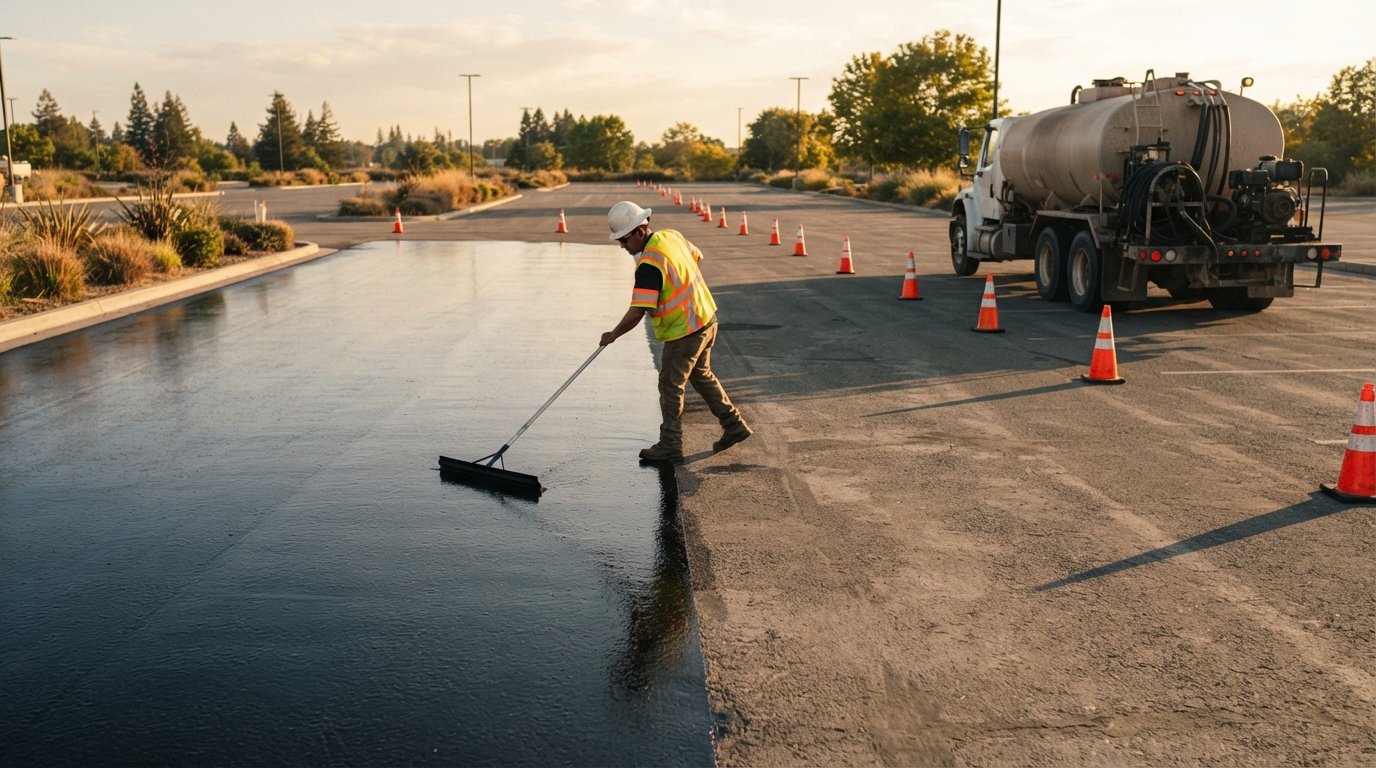
A proper sealcoating schedule interrupts that cycle. Fresh sealcoat restores a protective layer over the binder, blocks UV penetration, and resists water intrusion. It also restores the deep black finish that helps parking lot striping stand out, which improves safety and appearance. The key word is schedule. A single application buys you roughly two to four years of protection depending on traffic and climate. Applying it too soon wastes money. Applying it too late means you are sealing over damage that should have been repaired first.
For commercial properties in the East Bay, where summers are hot and dry and winters bring concentrated rain, the oxidation clock runs faster than in milder climates. That makes cadence planning especially important for shopping centers, restaurant sites, school district lots, and HOA drives.
The Standard Sealcoating Interval for Commercial Pavement
The most common recommendation in the paving industry is to sealcoat every two to three years for commercial parking lots. That range assumes normal traffic volumes, a properly constructed asphalt section, and standard maintenance between applications. Some properties can stretch to four years. Others, particularly restaurant sites with heavy delivery truck traffic or school lots with bus traffic, may need attention closer to the two year mark.
New asphalt is a special case. Freshly paved asphalt needs time to cure before sealcoat will bond properly. The general rule is to wait at least six months, and often a full year, after new asphalt is installed. Sealing too early traps oils and solvents that need to evaporate, which can lead to soft spots and premature failure. For a new shopping center or restaurant pad, that means the first sealcoat typically lands in the second year of service, then follows the normal two to three year cycle after that.
It helps to think in terms of a pavement life cycle rather than isolated projects. If a commercial lot is designed to last twenty years, a sealcoating schedule that hits every two to three years will deliver roughly six to eight applications over that span. Each one costs a fraction of what a mill and overlay would cost, and together they can push the need for major reconstruction out by five years or more.
Factors That Adjust Your Sealcoating Schedule
No two parking lots age at the same rate, so the two to three year baseline should be adjusted based on site specific conditions. Property managers who understand these variables can avoid both over sealing, which wastes budget, and under sealing, which allows damage to accelerate.
- Traffic volume and vehicle weight: Lots serving heavy delivery trucks, buses, or constant commuter turnover wear faster than lots with light passenger car use.
- Climate and sun exposure: Full sun exposure and wide temperature swings accelerate oxidation, while shaded lots may hold up longer.
- Asphalt age and quality: Older pavement with a thin or already oxidized surface needs more frequent attention than newer, well constructed sections.
- Drainage and water exposure: Poor drainage, ponding areas, and low spots force water into the surface and speed deterioration.
- Existing damage and prior repairs: Lots with existing cracks, potholes, or prior patching need repair work before sealcoat, which may change timing.
For example, a restaurant site with a drive thru lane and daily supply deliveries will almost always sit at the shorter end of the interval. A lightly used HOA guest parking area may comfortably sit at the longer end. The right answer comes from a site assessment, not a generic rule of thumb.
Seasonal Timing: When to Schedule Sealcoating in the East Bay
Sealcoat needs warm, dry conditions to cure properly. In the East Bay, the practical sealcoating window runs from late spring through early fall, roughly April through October. During that window, daytime temperatures are consistently high enough for the material to set, and rain is unlikely to interrupt the cure. Applying sealcoat in cool or damp conditions can lead to poor adhesion, tracking, and a finish that fails within a year.
That seasonal constraint has real planning implications. If you wait until October to start thinking about sealcoating, you may miss the window entirely and push the project to the following spring. For properties that also need crack filling, patching, or striping, the work should be sequenced so that repairs happen first, sealcoat cures, and striping is applied last, all within the same dry season.
School districts and HOAs often have additional timing considerations. School lots are easiest to sealcoat during summer break, when student and staff traffic is minimal and the lot can be closed in sections. HOA lots may need to be phased so that residents always have access to parking. Planning the schedule around these operational realities is just as important as planning around the weather.
How to Build a Multi Year Sealcoating Schedule
A sealcoating schedule is not a single date on a calendar. It is a rolling plan that accounts for pavement condition, budget cycles, and operational constraints. The most effective approach combines annual inspections with a multi year projection so that sealcoating never arrives as a surprise expense.
Start by documenting the current condition of the pavement. Note the date of the last sealcoat if known, the extent of cracking, the presence of potholes or alligator cracking, and any areas with poor drainage. From there, build a schedule that sequences repair, sealcoat, and striping across the next three to five years. This gives boards and finance teams a predictable number to plan around rather than a reactive scramble.
- Inspect the lot annually: Walk the pavement each spring and note new cracks, fading, and surface wear.
- Repair before sealing: Fill cracks, patch potholes, and address drainage issues before any sealcoat is applied.
- Apply sealcoat within the recommended interval: Two to three years for most commercial lots, adjusted for traffic and climate.
- Restripe after cure: Refresh parking stalls, fire lanes, ADA markings, and directional arrows once the sealcoat has fully cured.
- Review the plan each budget cycle: Update the schedule based on actual wear and any changes in site use.
Following this sequence keeps the pavement in service, protects the investment, and gives decision makers a clear story to tell their boards, districts, or ownership groups. It also makes it easier to bundle sealcoating with other maintenance work, which can reduce mobilization costs and disruption.
Repair First, Seal Second: Why Sequencing Matters
One of the most common mistakes property owners make is sealing over damaged pavement. Sealcoat is a protective coating, not a structural repair. If cracks are left open, sealcoat bridges them temporarily and then cracks reappear within months. If potholes or alligator cracking are present, sealcoating them without proper repair simply hides the problem while water continues to undermine the subbase beneath.
The correct sequence is repair, then seal, then stripe. Crack filling with a proper hot pour or cold pour material restores the surface continuity and keeps water out. Patching restores load bearing capacity in failed areas. Once those repairs have cured, sealcoat can be applied uniformly across the lot. Striping comes last so that the fresh layout sits on top of the finished surface.
This sequencing is especially important for commercial properties where liability exposure is a concern. Faded or missing striping, unmarked fire lanes, and deteriorated ADA spaces can create safety and compliance issues. A sealcoating schedule that includes striping as a standard step keeps the lot compliant and legible year after year.
Budgeting and Planning Considerations
Sealcoating is one of the lowest cost per square foot maintenance services available for asphalt, but the cost still needs to fit into a capital plan. For HOAs, school districts, and commercial property managers, the challenge is often less about the total cost and more about timing and predictability. A schedule converts an unpredictable expense into a known line item.
It also helps to think about sealcoating in the context of the overall pavement life cycle. A well maintained lot may need a mill and overlay every fifteen to twenty years. A neglected lot may need full reconstruction in ten. The difference in cost between those two paths is significant, and most of it comes down to whether a sealcoating schedule was followed.
When requesting quotes, ask for a scope that clearly separates crack filling, patching, sealcoating, and striping. That way you can compare bids accurately and phase work if budget requires it. A contractor who understands commercial pavement will typically recommend a schedule that aligns with your budget cycle rather than pushing a one time project.
Working With a Local Commercial Paving Partner
Sealcoating schedules work best when they are managed by a contractor who knows the local climate, the local pavement conditions, and the operational realities of your property type. In the East Bay, that means working with a team that handles both new construction grading and paving as well as ongoing asphalt maintenance for HOAs, school districts, and commercial sites.
DRT Grading & Paving provides grading, asphalt paving, and asphalt maintenance across the East Bay and surrounding areas. The company has completed new construction grading and paving for commercial projects including Chick-fil-A and Raising Cane's sites, shopping centers, and restaurant pads, and it also maintains existing pavement for HOAs, school districts, and other property owners. That combination of new construction and maintenance experience is useful when planning a sealcoating schedule, because it means the team understands how pavement was built as well as how it ages.
For property managers building a multi year plan, a site assessment is the logical first step. It establishes the current condition of the pavement, identifies repairs that should happen before sealing, and produces a realistic schedule that fits the property's budget and operating calendar.
An asphalt sealcoating schedule for commercial parking lots is ultimately a simple idea: protect the surface before it fails, repair what is already damaged, and repeat on a predictable cycle. Properties that follow that discipline spend less over time, avoid surprise reconstruction costs, and keep their lots safe, compliant, and presentable. For East Bay property owners and developers, the right schedule starts with a conversation and a walk of the lot, and it pays off for decades.