
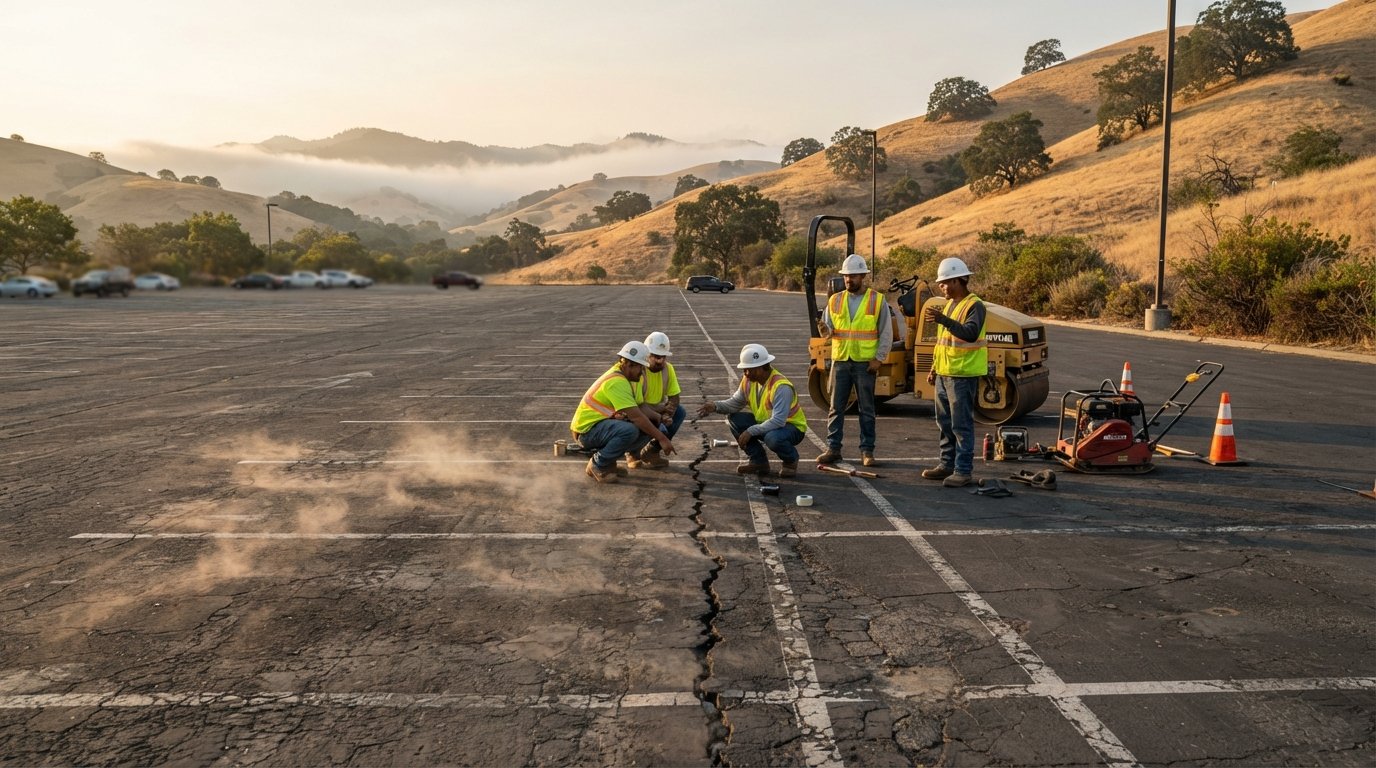
East Bay Climate Impact on Asphalt Paving
See how the East Bay climate impact on asphalt paving affects your project. Call DRT Grading & Paving at 9258629900 for expert grading, paving, and maintenance.

By Jack Griffin
Learn more about asphalt maintenance for guides, costs, and what to expect.
Planning a grading or paving job?
Send the project details, a budget range, and when you want to start.
The East Bay's climate is a quiet but powerful force on every commercial parking lot, drive lane, and loading zone in the region. Developers planning a new shopping center, restaurant pad, or school site often focus on design, traffic flow, and budget, but the weather patterns that roll across Alameda and Contra Costa counties will do more to determine how that asphalt performs over the next decade than almost any other single factor. Heat spikes in Walnut Creek, fog and moisture in Oakland and Berkeley, and seasonal shifts inland all place distinct demands on pavement. Understanding the East Bay climate impact on asphalt paving is not an academic exercise; it directly shapes how long a surface lasts, how often it needs repair, and what it costs to own.
For commercial property developers, HOAs, and school districts, that knowledge translates into decisions about timing, materials, and maintenance schedules. DRT Grading & Paving works across the East Bay on both new construction and ongoing asphalt maintenance, and the company sees firsthand how local conditions affect projects from the first day of grading to the ten-year mark. This article breaks down the specific climate factors at play, how they interact with asphalt, and what property owners and developers can do to protect their investment.
How East Bay Weather Patterns Shape Asphalt Performance
The East Bay is not a single climate zone. It is a patchwork of microclimates that can vary dramatically over just a few miles. The marine layer that cools Oakland, Berkeley, and Alameda keeps summer temperatures moderate but introduces persistent moisture. Inland areas like Concord, Walnut Creek, and Livermore experience much hotter summers, with temperatures regularly pushing past 95 degrees Fahrenheit and occasionally exceeding 100. The Diablo Range and the hills between the bay and the valley create rain shadows and wind patterns that further differentiate one project site from another.
Asphalt is a viscoelastic material, meaning its behavior changes with temperature and time. At high temperatures, it softens and can deform under traffic loads. At low temperatures, it becomes brittle and more prone to cracking. When moisture is present, it can weaken the bond between the asphalt binder and the aggregate, leading to stripping and raveling. The East Bay's climate pushes asphalt through these states repeatedly over the course of a year, and sometimes within a single week.
Consider a parking lot in Walnut Creek. In July, surface temperatures on dark asphalt can reach 140 degrees Fahrenheit or higher, even when the air temperature is in the mid-90s. That heat softens the binder, and heavy delivery trucks or garbage trucks turning in place can create ruts and shoving. By January, the same lot may see overnight temperatures in the 30s, causing the surface to contract. If the asphalt was not designed with the right binder grade and mix design, that contraction can open cracks that let water in. Once water enters the base and subgrade, the damage accelerates.
Heat, Thermal Cycling, and Pavement Deformation
Thermal cycling is the repeated expansion and contraction of asphalt as temperatures rise and fall. In the East Bay, daily temperature swings can be significant, especially inland. A pavement that expands in the afternoon heat and contracts overnight is under constant stress. Over time, that stress manifests as fatigue cracking, which often starts as a series of parallel cracks and eventually forms a pattern resembling alligator skin.
Heat also contributes to rutting, which is the longitudinal depression that forms in wheel paths. Rutting happens when the asphalt binder is too soft for the local climate or when the mix design does not provide enough stability. In the hotter parts of the East Bay, a standard mix designed for a milder climate may not hold up. This is why binder grade selection matters. A PG 64-16 binder, for example, is rated for higher temperatures than a PG 58-22, and the choice depends on the expected high and low temperatures at the project site.
For developers building new commercial sites, the grading and paving phase is the best opportunity to address thermal performance. Proper subgrade preparation, adequate compaction, and the right asphalt mix can mean the difference between a lot that needs major repairs in five years and one that performs well for fifteen or more. DRT Grading & Paving handles both the grading and paving scopes for new commercial construction, which means the same team that prepares the ground is also placing the asphalt. That continuity helps ensure the pavement is matched to the site conditions.
Moisture, Rain, and the Marine Layer
Moisture is the other major climate factor in the East Bay. Rain is concentrated in the winter months, but the marine layer can keep surfaces damp well into the morning even during the dry season. Water is asphalt's most persistent enemy. It seeps into cracks, weakens the bond between aggregate and binder, and eventually reaches the base course. Once the base is saturated, it loses strength, and the asphalt above it begins to fail.
The East Bay's rainy season typically runs from November through March, with most of the annual precipitation falling in those months. During that period, pavement that already has cracks or failed sealant will take on water. If the water freezes overnight in the colder inland areas, it expands and widens the cracks further. This freeze-thaw cycle is less severe than in mountain regions, but it still contributes to pavement deterioration in the eastern and southern parts of the East Bay.
Drainage is a critical design consideration for any commercial site. Parking lots that are not properly graded to direct water toward drains or bioswales will hold water in low spots, creating puddles that accelerate deterioration. For HOAs and school districts managing existing lots, standing water after a storm is a clear sign that drainage or pavement condition needs attention. Addressing those issues early, through crack sealing, patching, or sealcoating, can prevent more expensive repairs later.
Microclimate Differences Across the East Bay
One of the challenges of paving in the East Bay is that there is no single answer to the question of what will work. A mix design that performs well in Berkeley may fail prematurely in Brentwood. A maintenance schedule that makes sense for a shaded lot in Alameda may be inadequate for a sun-exposed lot in Pleasanton. Local expertise matters because local conditions vary.
The following list outlines the primary microclimate zones and their implications for asphalt:
- Bay-influenced areas (Oakland, Berkeley, Alameda, Richmond): Moderate temperatures, frequent morning moisture, and limited extreme heat. Asphalt here faces less thermal stress but more moisture exposure. Drainage and sealcoating are key.
- Inland valleys (Walnut Creek, Concord, Pleasanton, Livermore): Hot summers, cooler winters, and significant daily temperature swings. Rutting and thermal cracking are the primary concerns. Binder selection and mix design are critical.
- Hill and canyon areas (Lamorinda, Diablo, San Ramon hills): Variable exposure, wind, and occasional freezing temperatures. Pavement may face both heat and cold stress, requiring a more robust mix.
- Southern and eastern edges (Brentwood, Discovery Bay, parts of the Tri-Valley): The hottest summer temperatures in the region, with the greatest risk of rutting and oxidation. Maintenance intervals may need to be shorter.
Understanding which zone a project falls into helps determine the right asphalt specification, the right construction timing, and the right maintenance plan. DRT Grading & Paving brings this local knowledge to every project, whether it is a new Chick-fil-A pad in the Tri-Valley or an HOA parking lot in the Oakland hills.
Implications for New Commercial Construction
For developers planning new commercial projects, the East Bay climate impact on asphalt paving begins at the grading stage. The subgrade must be properly compacted and shaped to support the pavement structure and to drain water away from the surface. If the subgrade is not stable, no amount of high-quality asphalt will compensate. In areas with expansive soils, which are common in parts of the East Bay, additional measures such as lime treatment or geogrid reinforcement may be necessary.
The paving phase itself must be timed to avoid extreme weather. Asphalt should not be placed when the surface is wet or when temperatures are too low for proper compaction. In the East Bay, that generally means avoiding the peak of the rainy season and scheduling work for the drier months. Summer heat, while generally favorable for paving, can also be a challenge if the mix arrives too hot or if compaction is delayed. Experienced paving crews know how to adjust their operations to the conditions of the day.
Mix design is another critical factor. The asphalt binder grade should be selected based on the expected temperature range at the site. For hotter inland areas, a stiffer binder or a polymer-modified binder may be appropriate to resist rutting. For areas with colder winters, a softer binder may be needed to resist thermal cracking. The aggregate gradation and the use of additives such as polymers or fibers can also influence performance.
DRT Grading & Paving has completed new construction grading and paving for high-profile commercial clients, including Chick-fil-A and Raising Cane's locations. These projects require precise coordination between grading, utilities, and paving, and they demand a thorough understanding of how the local climate will affect the finished surface. The same expertise applies to shopping centers, office parks, and other commercial developments.
Maintenance Strategies for Existing Pavement
For property owners with existing asphalt, the East Bay climate means that maintenance cannot be an afterthought. The combination of heat, moisture, and thermal cycling will degrade pavement over time, but the rate of degradation depends on how well the surface is protected. A proactive maintenance plan can extend the life of a parking lot by years and avoid the need for full-depth reconstruction.
The most effective maintenance strategies for East Bay properties include:
- Regular inspections: Walk or drive the lot at least twice a year, looking for new cracks, potholes, standing water, and areas of raveling or rutting. Early detection is the key to low-cost repairs.
- Crack sealing: Fill cracks before water can enter the base. This is typically done every two to three years, depending on pavement condition and exposure.
- Sealcoating: Apply a protective coating to slow oxidation and protect the surface from moisture and UV damage. Sealcoating is most effective when applied before significant cracking occurs.
- Patching and pothole repair: Address localized failures promptly to prevent them from spreading. Potholes are a safety hazard and a liability concern.
- Drainage maintenance: Keep drains, swales, and gutters clear so water flows away from the pavement. Poor drainage is a leading cause of premature pavement failure.
HOAs and school districts often have large parking areas that are used heavily during the school year or peak seasons. Scheduling maintenance during slower periods, such as summer break for schools, allows work to be completed without disrupting daily operations. DRT Grading & Paving provides asphalt maintenance services tailored to these clients, helping them preserve their pavement and manage budgets.
Planning and Budgeting for Climate Resilience
Property owners and developers who understand the East Bay climate impact on asphalt paving can plan more effectively. Instead of reacting to failures as they occur, they can budget for routine maintenance and anticipate when major repairs will be needed. This approach typically costs less over the life of the pavement and avoids the disruption and expense of emergency repairs.
A useful framework is to think in terms of pavement life cycles. A newly constructed asphalt lot in the East Bay might have a service life of 15 to 20 years if properly designed and maintained. Without maintenance, that life might be cut to 10 years or less. The cost of a sealcoat and crack sealing every few years is a fraction of the cost of a mill-and-overlay or full reconstruction. By spreading maintenance costs over time, property owners can avoid large, unexpected expenditures.
For new construction, the upfront investment in proper grading, a suitable mix design, and quality compaction pays dividends over the life of the pavement. Developers who cut corners on the base or the asphalt mix often find themselves dealing with warranty claims, tenant complaints, and premature repairs. Working with a contractor who understands the local climate and builds accordingly is the best way to protect that investment.
Working with a Local East Bay Paving Contractor
The East Bay's climate is not uniform, and neither are its paving needs. A contractor who works regularly in the region knows which mix designs perform best in which areas, how to schedule work around the rainy season, and how to spot the early signs of climate-related pavement distress. That local knowledge is difficult to replicate from outside the area.
DRT Grading & Paving is based in the East Bay and serves commercial developers, HOAs, school districts, and other property owners throughout the region. The company's services include site grading for new commercial construction, asphalt paving for shopping centers and restaurant sites, and asphalt maintenance for existing properties. Whether the project is a new Chick-fil-A in the Tri-Valley or a school district parking lot in Contra Costa County, the team brings a practical understanding of how local weather will affect the work.
For developers, that means a grading and paving partner who can coordinate the site work from the ground up. For property owners, it means a maintenance provider who can assess pavement condition and recommend the right repairs at the right time. In both cases, the goal is the same: build and maintain asphalt that stands up to the East Bay climate.
If you are planning a new commercial project or need to address wear on an existing lot, contact DRT Grading & Paving at 9258629900 or visit the website to request a quote. The team can evaluate your site, explain how the local climate will affect your pavement, and provide a clear plan for construction or maintenance.