East Bay Commercial Paving Project Case Study: From Grading to Grand Opening
This East Bay commercial paving project case study shows how proper grading and base work deliver a durable restaurant parking lot. Call 9258629900.

By Daniel Hayes
Learn more about asphalt maintenance for guides, costs, and what to expect.
Planning a grading or paving job?
Send the project details, a budget range, and when you want to start.
When a national restaurant chain needed a new East Bay location built on a tight schedule, DRT Grading & Paving handled site grading and asphalt paving from the ground up. This East Bay commercial paving project case study walks through the full scope of work, from initial soil preparation to the final striped parking lot, and shows what developers can expect when they partner with a local contractor who understands both the technical demands and the regulatory landscape of the region.
Commercial paving projects in the East Bay are rarely simple. Soil conditions vary from expansive clay to sandy loam, winter rains can delay grading operations, and local jurisdictions enforce strict stormwater and accessibility requirements. For developers building shopping centers, restaurant pads, and mixed-use sites, the grading and paving phase is often the most visible and schedule-sensitive part of the project. Delays in this phase ripple into tenant openings, certificate of occupancy dates, and revenue projections.
The project profiled here involved a ground-up restaurant pad for a well-known quick-service brand, a type of work DRT Grading & Paving has completed for chains including Chick-fil-A and Raising Cane's. While every site is different, the sequence of grading, paving, and punch-list closeout follows a pattern that applies broadly to East Bay commercial development. Understanding that pattern helps property owners and general contractors ask the right questions, set realistic timelines, and avoid costly change orders.
Project Snapshot and Site Conditions
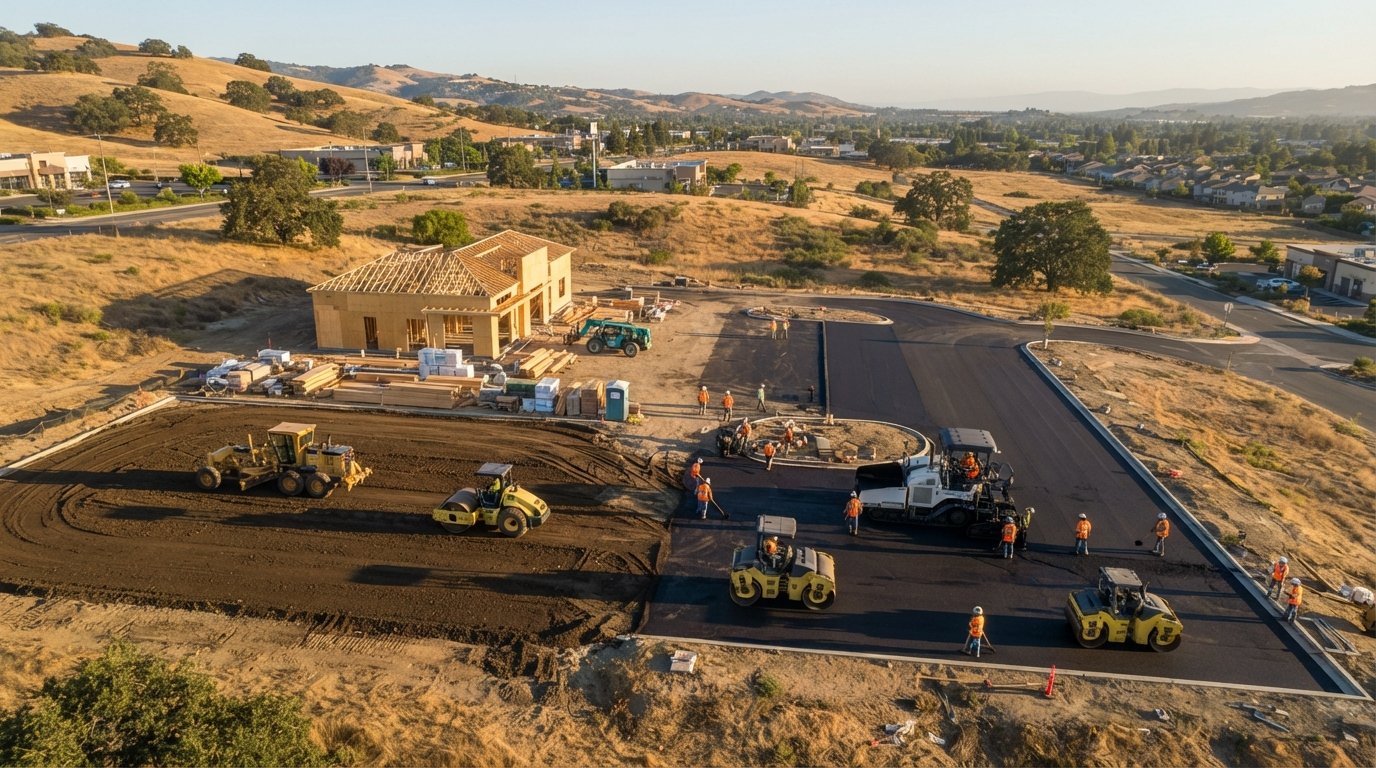
The site was a roughly one-acre pad within an existing commercial corridor, bordered by a shared driveway and a neighboring retail center. The developer needed a finished parking lot, drive-through lane, and accessible parking stalls that could support the restaurant's opening volume on day one. The existing ground had been rough-graded by an earlier earthwork contractor, but it had not been fine-graded or compacted to the tolerances required for asphalt placement.
Soil testing revealed a mix of silty clay and gravelly fill, with moisture content higher than ideal for compaction. That is a common finding in the East Bay, where winter and spring rains saturate soils and leave them unstable under load. The DRT team began with a site assessment that included reviewing the geotechnical report, verifying utility locations, and checking drainage patterns to ensure water would sheet away from the building pad and parking areas rather than pooling at the asphalt edge.
One early decision shaped the entire schedule: whether to over-excavate and replace unsuitable soil or to stabilize it in place with lime or cement treatment. The geotechnical engineer recommended removal of the top layer of soft clay and replacement with engineered fill, a more predictable approach that added a few days to the front end but reduced the risk of future settlement and cracking. Getting this decision right before paving is one of the most important lessons of any East Bay commercial paving project case study, because fixing subgrade problems after asphalt is placed can cost several times more than addressing them upfront.
Grading and Subgrade Preparation
Grading is the foundation of every successful paving project. As DRT Grading & Paving puts it, grading prepares the ground before asphalt goes down. On this site, that meant cutting and filling to the design elevations shown on the civil plans, then compacting the subgrade in lifts to the density specified by the geotechnical engineer. Each lift was tested for moisture and compaction before the next layer was placed.
The team also installed and tied into storm drainage structures, adjusted utility boxes to finished grade, and shaped the subgrade to create positive drainage toward catch basins and the street. Poor drainage is one of the leading causes of premature asphalt failure in the East Bay, where seasonal rains can saturate base layers and soften the subgrade under repeated traffic loads. By confirming slope and flow lines during grading, the crew avoided low spots that would have required patching later.
Key steps in the grading phase included:
- Clearing and grubbing the pad, then removing unsuitable soil as recommended by the geotechnical report
- Placing and compacting engineered fill in lifts, with density testing at each stage
- Rough grading to within a tenth of a foot of design elevations, then fine grading to tighter tolerances
- Installing drainage inlets, adjusting utility covers, and verifying positive slope away from the building
- Proof-rolling the subgrade to identify soft spots before base rock placement
Once the subgrade passed inspection, the crew placed Class 2 aggregate base rock and compacted it to the specified depth. Base rock acts as the structural layer that spreads traffic loads and protects the subgrade from moisture. On this project, the base was placed in two lifts and watered and rolled to achieve the required compaction. The result was a firm, uniform platform ready for asphalt. Skipping or rushing this step is one of the most common causes of rutting and alligator cracking in commercial lots, which is why DRT treats base preparation as a non-negotiable part of the scope.
Asphalt Paving and Finishing
With the base approved, paving began on a day when weather and plant schedules aligned. Hot-mix asphalt has to be placed within a specific temperature range, and the haul distance from the plant to the East Bay site had to be short enough to keep the mix workable. The crew started with a tack coat to bond the new asphalt to the base, then placed the binder course, followed by the surface course.
For a commercial parking lot and drive-through lane, the typical section includes two to three inches of asphalt over four to six inches of aggregate base, depending on traffic loading and the geotechnical recommendations. Drive-through lanes and dumpster areas often receive a heavier section because they carry concentrated loads from trucks and delivery vehicles. On this project, the team placed the binder and surface courses in sequence, rolling each pass to achieve density while the mix was still hot. Joints between passes were matched carefully to create a smooth, even surface.
After the asphalt cooled, the crew completed the finishing work that turns a paved surface into a functional parking lot:
- Striping parking stalls, accessible spaces, fire lanes, and directional arrows per the approved site plan
- Installing wheel stops, bollards, and signage where required
- Patching utility trenches and any areas disturbed during construction
- Cleaning the lot and adjacent street of construction debris
- Walking the site with the developer and general contractor for a final punch list
ADA compliance was a central concern throughout the finishing phase. Accessible stalls must connect to an accessible route with proper slope and cross-slope, and the path of travel from the parking lot to the building entrance must meet current standards. Because the East Bay has many older commercial centers with non-compliant lots, developers building new pads adjacent to existing improvements often need to upgrade shared paths of travel, not just the new stalls. Addressing these details during the paving phase is far less expensive than retrofitting them after the restaurant opens.
From start to finish, the grading and paving scope on this project took several weeks, with most of that time dedicated to subgrade preparation and base installation. The actual asphalt placement happened over a few days, weather permitting. That ratio is typical for commercial work: the visible paving is quick, but the invisible prep work determines how long the pavement will last.
Challenges, Solutions, and Lessons Learned
The biggest challenge on this project was moisture. Late-season rains had left the subgrade wetter than optimal, and the team had to pause grading operations at one point to allow the soil to dry and to re-test compaction. Rather than pushing forward and risking a soft base, the crew used the downtime to complete drainage work and prepare other areas of the site. That decision kept the overall schedule on track because it prevented a much longer delay down the road.
Coordination with the general contractor and utility companies was another moving part. Utility trenches that are backfilled and compacted to a lower standard than the surrounding subgrade are a common source of future settlement, so the paving crew paid extra attention to those areas, over-excavating and re-compacting where needed. This is the kind of detail that does not show up on a schedule but shows up years later as a dip or crack in the parking lot.
For developers planning similar projects, several lessons stand out:
- Invest in geotechnical testing early, because subgrade conditions drive both cost and schedule
- Do not compress the grading and base phase to save time, since shortcuts there shorten pavement life
- Confirm drainage and utility elevations before paving, not after
- Build ADA compliance into the plan from the start, especially on infill sites
- Choose a paving contractor who self-performs grading and asphalt work, so accountability stays with one team
DRT Grading & Paving's ability to handle both grading and paving under one contract simplified coordination for the developer. Instead of managing separate earthwork, base, and paving subcontractors, the developer had a single point of responsibility for the site work. That structure tends to reduce finger-pointing when issues arise and makes it easier to hold the schedule.
Why Local Expertise Matters in the East Bay
East Bay commercial paving is not the same as paving in other regions. Jurisdictions like Oakland, Fremont, Hayward, and Concord each have their own inspection processes, stormwater requirements, and accessibility interpretations. Soil conditions change from one city to the next, and rainfall patterns affect when grading and paving can realistically be scheduled. A contractor who works in the region every day knows which inspectors want to see which details, how long permits typically take, and how to sequence work around the rainy season.
Local expertise also matters for maintenance after the project is complete. Commercial parking lots in the East Bay take a beating from sun, rain, and heavy traffic. Seal coating every few years, crack filling, and timely patching can extend the life of asphalt by a decade or more. For HOAs, school districts, and shopping center owners, a maintenance plan is not optional; it is the difference between a smooth lot and a liability claim.
DRT Grading & Paving serves both sides of the market: new construction grading and paving for shopping centers and restaurant sites, and asphalt maintenance for HOAs, school districts, and other property owners. That combination gives the company a long view of pavement performance. They see how today's installation decisions affect tomorrow's maintenance costs, and they bring that perspective to every project.
Applying This Case Study to Your Project
If you are planning a new commercial development in the East Bay, the sequence in this case study is a useful template. Start with geotechnical investigation, finalize drainage and utility design, grade and compact the subgrade, install and test the base, then pave and stripe. Build in contingency for weather and soil conditions, and resist the temptation to compress the prep work. The asphalt surface is what everyone sees, but the grading and base are what everyone depends on.
If you own an existing commercial property, the same principles apply in reverse. Catching drainage problems, failing base, and surface cracking early keeps small repairs from becoming full reconstructions. A pavement maintenance plan that includes regular inspections, crack sealing, and seal coating protects your investment and keeps your lot safe for customers and tenants.
Every successful East Bay commercial paving project case study comes down to the same fundamentals: proper subgrade preparation, correct base installation, quality asphalt, and attention to drainage and compliance. Developers who prioritize those fundamentals get lots that open on time and perform for years. Property owners who maintain them get the maximum life out of their pavement investment. DRT Grading & Paving brings that full lifecycle perspective to every project, from the first cut of the grader to the last stripe of paint.