Parking Lot Drainage Solutions for Asphalt Longevity
Protect your asphalt with proven parking lot drainage solutions. Call DRT Grading & Paving at 9258629900 for East Bay expertise.

By Daniel Hayes
Learn more about asphalt maintenance for guides, costs, and what to expect.
Planning a grading or paving job?
Send the project details, a budget range, and when you want to start.
Water is the single most destructive force acting on an asphalt parking lot. It seeps into hairline cracks, freezes and expands, then melts and contracts, prying the pavement apart from the inside. It pools in low spots and softens the subgrade until the surface above collapses into potholes and alligator cracking. For commercial property owners, HOA boards, and school district facility managers across the East Bay, the difference between a lot that lasts 20 years and one that needs full replacement in eight often comes down to one thing: how well that lot moves water away from the pavement. This article breaks down the parking lot drainage solutions that protect asphalt longevity, from the grading decisions made before a single ton of mix is laid to the maintenance practices that keep existing lots performing through decades of California wet seasons and dry summers.
Why Drainage Is the Foundation of Asphalt Longevity
Asphalt pavement is a layered system. The visible surface course sits on top of a base layer, which sits on compacted subgrade soil. Each layer depends on the ones below it for structural support. When water infiltrates the surface and cannot drain away, it travels downward until it hits an impermeable layer or the water table, and in the process it weakens every layer it touches. Saturated subgrade soil loses bearing capacity. Saturated base aggregate loses its interlock. The asphalt above then flexes under traffic loads it was never designed to carry, and fatigue cracking begins.
The mechanics are unforgiving. A pavement section designed for a given traffic load assumes a dry or well-drained subgrade. Once that assumption fails, the effective strength of the entire system drops dramatically. This is why two parking lots built with identical asphalt mix and thickness can perform completely differently: one was graded and drained correctly, and the other was not. In the East Bay, where winter storms can deliver sustained rainfall and clay-heavy soils hold moisture for weeks, this distinction matters more than in drier climates.
Standing water also accelerates surface deterioration directly. It oxidizes the asphalt binder faster, strips aggregate from the surface, and feeds the freeze-thaw and wet-dry cycles that open cracks wider each season. Sealcoating and crack filling help, but they cannot compensate for a lot that keeps water trapped against the pavement. Drainage has to come first. For property owners managing existing lots, this means that any serious asphalt maintenance plan starts with an honest assessment of where water goes, and where it should go instead.
Core Parking Lot Drainage Solutions for Asphalt Longevity
There is no single drainage solution that fits every lot. The right approach depends on the site's topography, soil type, water table depth, rainfall patterns, and the surrounding infrastructure. In practice, most commercial lots use a combination of the methods below, and the best designs layer them so that if one system is overwhelmed during a heavy storm, another takes over.
The most common drainage strategies for commercial parking lots include:
- Surface grading and slope: Shaping the lot so water flows toward inlets or off-site without ponding.
- Storm sewer inlets and catch basins: Collecting concentrated flow at low points and piping it away.
- Swales and bioswales: Vegetated channels that convey and infiltrate runoff.
- Perimeter and subsurface drains: Intercepting groundwater or lateral flow before it reaches the pavement section.
- Permeable pavement systems: Allowing water to pass through the surface into a storage and infiltration bed.
Each of these solutions addresses a different part of the water problem. Grading handles the bulk of surface flow. Inlets and storm sewer handle concentrated volumes. Swales and permeable systems manage runoff quality and volume, which can matter for local stormwater regulations. Subsurface drains protect the pavement from below. A well-designed lot typically uses grading as the primary defense, inlets and piping as the secondary defense, and subsurface or permeable elements where site conditions demand them.
Grading and Slope: The First Line of Defense
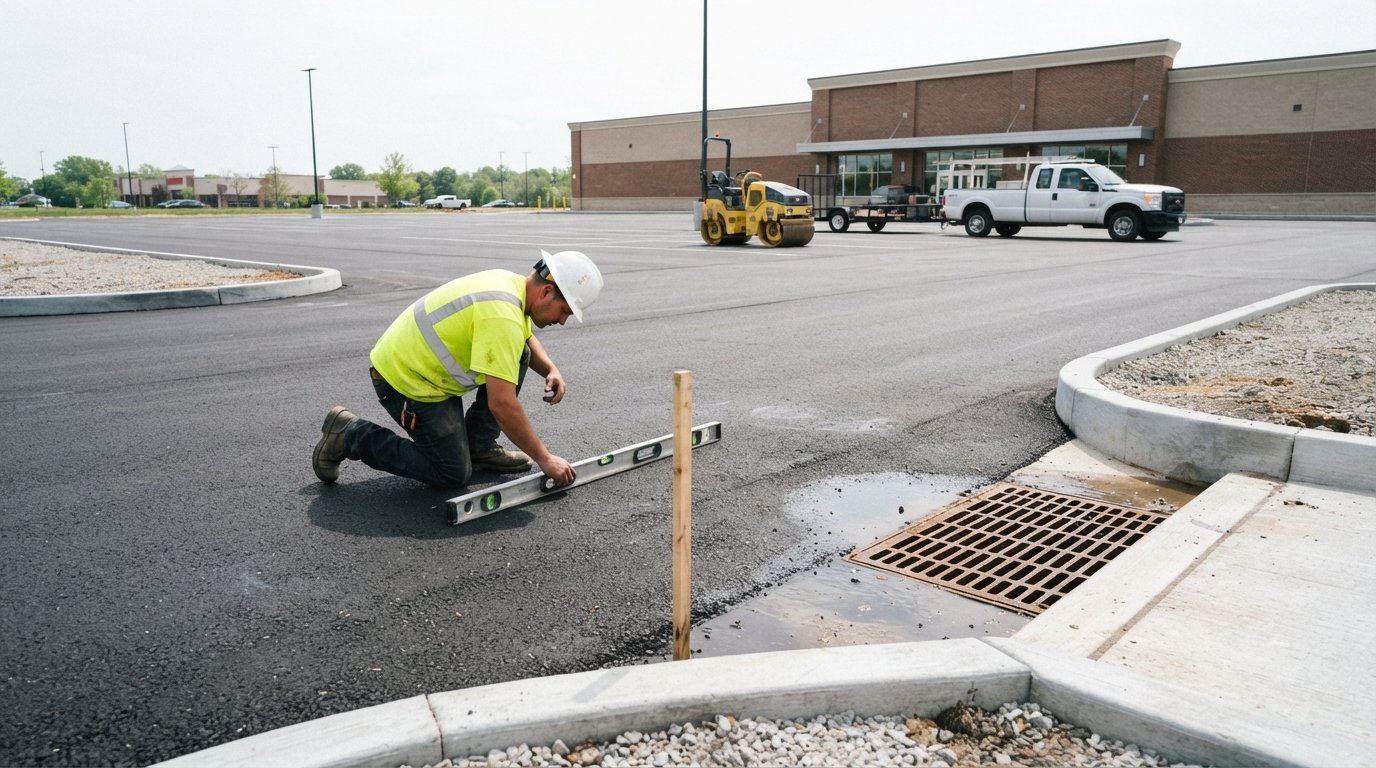
Every parking lot drainage plan begins with grading. The surface of the lot must be shaped so that water flows toward a collection point rather than sitting on the pavement. Industry guidance generally calls for a minimum slope of about 1 percent (1 foot of fall per 100 feet of run) on asphalt surfaces, with many designers targeting 1.5 to 2 percent in areas subject to heavy rainfall or where the surface is expected to settle slightly over time. Flatter slopes may be acceptable in some designs, but they leave less margin for error during construction and less tolerance for future settlement.
Grading is not just about the finished asphalt surface. It also involves shaping the subgrade and base layers so that water that does infiltrate can move laterally to edge drains or off-site rather than pooling under the pavement. This is where new construction grading expertise matters enormously. A contractor who understands both grading and paving can build a lot that drains correctly from the bottom up, not just one that looks flat on the surface. For developers building shopping centers or restaurant pads in the East Bay, this integrated approach avoids the expensive scenario of discovering drainage problems after the lot is paved and striped.
Existing lots can also benefit from re-grading, though the options are more limited. If a lot has settled into low spots that pond water, a mill-and-overlay project can restore positive drainage to those areas. In more severe cases, partial reconstruction of the base and subgrade may be necessary. Either way, the goal is the same: get water moving off the pavement before it has time to soak in.
Storm Sewer Inlets, Catch Basins, and Piping
Where grading alone cannot move water far enough or fast enough, storm sewer systems take over. Catch basins and area drains are placed at low points and along the edges of the lot to collect concentrated flow. From there, water travels through underground pipes to a discharge point, which might be a municipal storm drain, a retention basin, or an infiltration field on site.
The design of these systems is driven by local rainfall intensity and the size of the contributing drainage area. In the East Bay, storm events can deliver intense bursts of rain that overwhelm undersized inlets, so it is critical to size basins and pipes for the actual local storm frequency, not a generic national average. Inlets also need to be maintained. A catch basin clogged with leaves, sediment, and trash stops functioning as a drain and starts functioning as a puddle. For HOAs and school districts, a simple seasonal cleaning schedule can be the difference between a system that works for decades and one that fails in its first heavy winter.
Piping systems add another layer of complexity. They must be sloped correctly, bedded properly, and protected from root intrusion and sediment accumulation. When they work, they are invisible. When they fail, the evidence shows up as ponding, sinkholes, or saturated pavement edges. Regular inspection, ideally as part of an annual asphalt maintenance review, can catch small problems before they become major excavation projects.
Swales, Bioswales, and Vegetated Drainage
Vegetated swales and bioswales are shallow, planted channels that convey stormwater while allowing some of it to infiltrate and be filtered by soil and plant roots. They are particularly useful on sites where runoff quality is regulated, or where the owner wants to reduce the volume and velocity of water leaving the property. In commercial developments, they can double as landscaped buffers between the parking lot and adjacent properties or streets.
For asphalt longevity, the benefit of swales is that they provide a place for water to go that is not the pavement surface or the subgrade beneath it. By intercepting sheet flow from the lot and conveying it away at a controlled rate, they reduce the chance that water will pond at the edges of the pavement or back up into the base layer. They do require maintenance, including periodic mowing, sediment removal, and replacement of dead vegetation, but for many East Bay sites they are a cost-effective complement to traditional storm sewer systems.
Subsurface Drains and Underdrains
Sometimes the water problem is not on the surface at all. Sites with high water tables, springs, or lateral groundwater flow can experience water moving into the pavement section from below or from the sides. In these cases, subsurface drains and underdrains are essential. These systems typically consist of perforated pipes wrapped in filter fabric and surrounded by gravel, installed in trenches below or alongside the pavement. They intercept groundwater and carry it away before it can saturate the base and subgrade.
Underdrains are especially important in areas where the subgrade soil is clay-heavy and slow to drain. Without them, water that enters the pavement section can be trapped for long periods, weakening the base and accelerating pavement distress. During new construction, installing underdrains is relatively straightforward and cost-effective. Retrofitting them into an existing lot is more disruptive and expensive, which is why it is worth getting the drainage design right the first time.
Permeable Pavement and Infiltration Systems
Permeable asphalt and permeable concrete are alternatives to traditional impervious pavement that allow water to drain through the surface into a stone storage bed below. From there, water either infiltrates into the native soil or is collected by an underdrain system and piped away. These systems are particularly valuable on sites with limited space for detention ponds or where local regulations require on-site stormwater management.
Permeable pavement is not a universal replacement for conventional asphalt, but in the right setting it can be an excellent tool for both drainage and regulatory compliance. It requires careful design, proper base preparation, and regular vacuum sweeping to keep pores from clogging. For commercial developments in the East Bay that need to meet stormwater requirements while maximizing usable parking area, permeable systems are worth discussing with a contractor who understands both their benefits and their limitations.
Designing Drainage for New Commercial Construction
For developers building new shopping centers, restaurant pads, or other commercial sites, drainage design is not an afterthought. It is part of the site planning process from the beginning, alongside grading, utilities, and paving. The sequence matters: you cannot design the paving thickness or layout until you know how water will move across and off the site. You cannot design the storm sewer system until you know the grading plan. And you cannot finalize the grading plan until you understand the soils, the water table, and the downstream discharge options.
This is where working with a contractor that handles both grading and paving under one roof pays off. When the same team is responsible for shaping the ground and placing the asphalt, there is no gap between the drainage design and the pavement construction. The subgrade is prepared to drain, the base is shaped to shed water, and the surface is sloped to move runoff toward inlets that were sized for the actual contributing area. This integrated approach reduces the risk of callbacks, change orders, and long-term pavement failures.
For restaurant sites in particular, drainage design has to account for more than just rainfall. Grease, oil, and food waste can enter the storm system if proper pretreatment is not in place. A well-designed lot includes grease interceptors or separators where required, and grades the pavement so that wash-down water and spills are directed to the correct treatment point rather than into the storm drain. This protects both the pavement and the environment, and it helps the owner stay in compliance with local regulations.
Maintaining Drainage Systems in Existing Lots
Drainage systems are not install-and-forget infrastructure. Over time, inlets clog, pipes settle, swales fill with sediment, and pavement surfaces settle into new low spots. For HOAs, school districts, and other property owners managing existing lots, a proactive maintenance plan is the most cost-effective way to protect asphalt longevity and avoid emergency repairs.
A practical annual drainage maintenance checklist includes:
- Inspect and clean all catch basins, area drains, and inlets before the rainy season.
- Check for ponding after the first significant storm and identify any new low spots.
- Clear debris from swales, channels, and vegetated drainage features.
- Inspect pavement edges and joints for signs of water infiltration or base saturation.
- Schedule crack sealing and sealcoating to keep surface water out of the pavement structure.
These tasks are simple, but they require consistency. A lot that is inspected and maintained every year will outperform an identical lot that is only addressed when problems become visible. For property managers, the return on investment is straightforward: fewer potholes, fewer trip hazards, less emergency repair spending, and a pavement surface that lasts years longer than it otherwise would.
When maintenance reveals deeper problems, such as failed pipes, settled inlets, or saturated base areas, it is time to bring in a paving contractor for a more thorough assessment. In many cases, targeted repairs (replacing a section of pipe, re-grading a low area, or installing a new inlet) can solve the problem without full reconstruction. The key is to act before the water damage spreads to the point where the entire lot needs to be replaced.
East Bay Considerations: Soil, Rainfall, and Regulations
The East Bay presents a specific set of drainage challenges. Many areas have clay-heavy soils that drain slowly and expand when wet, which puts additional stress on pavement and makes proper subgrade preparation essential. Winter storms can deliver intense rainfall over short periods, testing the capacity of inlets and pipes. And local stormwater regulations increasingly require on-site treatment and detention, which means drainage design has to do more than just move water away; it has to manage it responsibly.
Working with a contractor who knows the local soils, rainfall patterns, and regulatory environment is a significant advantage. A drainage solution that works in a sandy, dry climate may fail completely in the East Bay. Conversely, a design that accounts for local conditions can protect a parking lot for decades. For developers and property owners alike, local expertise is not a luxury; it is a practical requirement for getting drainage right.
DRT Grading & Paving brings that local expertise to every project, from new commercial construction to ongoing asphalt maintenance. Whether the task is grading a new restaurant pad, paving a shopping center lot, or helping an HOA or school district keep an existing parking area in service, the focus is always on building and maintaining pavement that drains correctly and lasts. A lot that sheds water properly is a lot that stays smooth, safe, and structurally sound for years longer than one that does not.
If you are planning a new commercial project or managing an existing lot that shows signs of drainage problems, the right time to act is before the next rainy season. A thorough assessment of grading, inlets, and pavement condition can identify small issues before they become expensive failures, and a well-designed drainage plan can add years to the life of your asphalt. For East Bay property owners and developers, that combination of prevention and performance is the foundation of a parking lot that works as hard as the business it serves.